Introduction: Bigger Is Not Always Better for Enterprise AI
For the last few years, the AI conversation has been shaped by one idea.
Bigger models will solve bigger problems.
That belief made sense in the early phase of generative AI. Large Language Models proved that a single model could write, summarize, reason, code, translate and answer questions across almost any topic.
But enterprise AI is now entering a more practical phase.
Leaders are no longer asking only what AI can do.
They are asking what AI can do securely, privately, consistently and at a cost that can scale.
This is where the discussion around LLMs vs SLMs becomes important.
A large model may be the right choice for open ended reasoning, complex analysis and advanced generation. But many enterprise workflows are not open ended. They are repetitive, rule driven, domain specific and tied to known business processes.
A bank reviews similar KYC documents every day.
An insurer routes similar claims.
A retailer answers similar order questions.
A finance team extracts the same fields from invoices.
A legal team reviews recurring contract clauses.
A support team classifies similar tickets again and again.
These are not always jobs for a massive general purpose LLM.
They are often better suited for Task Specific Small Language Models.
Task Specific SLMs are compact, focused models built to perform one defined business task well. They are becoming important because enterprises want AI systems that are faster, cheaper, easier to govern, easier to deploy privately and better aligned with Sovereign LLM requirements.
In other words, the future of enterprise AI is not only about bigger models.
It is about using the right model for the right workflow.
What Are Task Specific Small Language Models?
A Task Specific Small Language Model is a compact language model trained, fine tuned or configured to perform one clearly defined business task.
It is not built to answer every possible question.
It is built to handle a specific workflow with speed, consistency and lower operating cost.
A Task Specific SLM may be designed to:
- Classify support tickets
- Extract data from invoices
- Review contract clauses
- Route insurance claims
- Answer internal policy questions
- Summarize patient intake notes
- Detect compliance gaps
- Match purchase orders
- Process KYC documents
- Draft routine customer responses
- Identify risk signals in operational reports
- Search and answer from approved enterprise documents
The key word here is specific.
A general LLM is designed to be broad.
A Task Specific SLM is designed to be useful in one defined area.
That focus makes it valuable for enterprise clients.
It can be faster.
It can be cheaper to run.
It can be easier to govern.
It can be easier to deploy privately.
It can be easier to test against a known business outcome.
This matters because enterprise AI success is not about using the largest model everywhere.
It is about solving real business problems with reliability, privacy and cost control.
Why Enterprises Are Looking Beyond General Purpose LLMs
Large Language Models are powerful. They will continue to play an important role in enterprise AI.
But using a large model for every task creates problems.
The most common issues are:
- High LLM token costs
- Rising AI inference cost
- Longer response time
- More infrastructure dependency
- More complex governance
- Greater data exposure risk
- Unpredictable usage patterns
- Difficulty in measuring return on investment
- Overuse of premium models for simple tasks
In a pilot, these issues may not feel urgent.
But once AI moves into production, the numbers change.
Hundreds of users become thousands.
A few documents become millions of records.
A chatbot becomes an agent.
A small workflow becomes a daily operating system.
A simple prompt becomes a long context window.
A low cost experiment becomes a recurring expense.
This is why many enterprises are now questioning a model strategy based only on LLMs.
The better question is not:
Which is the most powerful model?
The better question is:
Which model is right for this task, this data, this cost limit and this governance requirement?
That is where Enterprise SLMs and Task Specific SLMs become important.
LLMs vs SLMs: What Enterprises Need to Understand
The comparison of LLMs vs SLMs is not about choosing one and rejecting the other.
It is about understanding where each model type fits.
LLMs are strong when the task requires broad knowledge, flexible reasoning, complex writing or multi step problem solving.
SLMs are strong when the task is focused, repeated, domain specific and cost sensitive.
For example, an LLM may be better for:
- Complex legal reasoning
- Strategy analysis
- Open ended research
- Advanced code generation
- Multi document reasoning
- Exception handling
- New or ambiguous user questions
An SLM may be better for:
- Ticket classification
- Invoice field extraction
- Claims routing
- Policy question answering
- Contract clause tagging
- Product support workflows
- Internal document search
- Compliance checklist review
The difference is not only technical.
It is operational.
LLMs give enterprises broader capability.
SLMs give enterprises better efficiency, speed, privacy and control for specific workflows.
The best enterprise AI strategy usually needs both.
LLM vs SLM vs MLM: A Practical Enterprise View
Many teams also ask about LLM vs SLM vs MLM.
The terms can be confusing, so here is a practical way to understand them.
In this article, MLM means Medium Language Model. It refers to a model that sits between a large general purpose LLM and a compact SLM.
| Model Type | Meaning | Best Used For | Enterprise Consideration |
|---|---|---|---|
| LLM | Large Language Model | Broad reasoning, content generation, coding, analysis and open ended tasks | Powerful, but can create higher token cost, governance complexity and infrastructure dependency |
| MLM | Medium Language Model | Mid sized model between a large LLM and a compact SLM | Useful when the task needs more capability than an SLM but does not justify the cost of a large LLM |
| SLM | Small Language Model | Focused, lower cost and faster language tasks | Easier to deploy privately and useful for high volume enterprise workflows |
| Task Specific SLM | SLM trained or tuned for one defined business task | Claims routing, KYC review, invoice extraction, contract tagging and support classification | Best for repeatable workflows where consistency, privacy and cost control matter |
The goal is not to force every enterprise use case into one category.
The goal is to create a model portfolio.
Some tasks need an LLM.
Some tasks need an MLM.
Some tasks need an SLM.
Some tasks need a Task Specific SLM.
Some tasks still need a human reviewer.
That is the mature way to think about enterprise AI architecture.
What Is Token Maxxing and Why Does It Matter?
Token Maxxing is an emerging way to describe a common AI cost problem.
It happens when teams keep increasing prompt size, context size, retrieval volume, model calls and agent steps without enough discipline around actual business value.
In simple words, Token Maxxing means using more tokens than the task really needs.
This can happen when:
- Every task is sent to a large LLM
- Prompts are too long
- Too many documents are passed into the model
- Context windows are filled without filtering
- Agents keep retrying without limits
- The system uses long responses where short answers would work
- There is no model routing between LLMs and SLMs
- Teams do not track token usage by workflow
Token Maxxing may not look dangerous during a small pilot.
But at enterprise scale, it can quietly turn into a serious cost problem.
A single request may look simple to the user.
Behind the scenes, it may involve long prompts, private RAG retrieval, multiple model calls, tool usage, retry loops and a large generated response.
That entire workflow consumes tokens.
This is why Task Specific SLMs matter.
They help enterprises avoid using a large LLM for simple, repeatable work.
Instead of Token Maxxing every workflow, enterprises can route focused tasks to smaller models with lower inference cost and more predictable output.
Why Task Specific SLMs Help Reduce LLM Token Costs
High LLM token costs are becoming one of the biggest barriers to enterprise AI scale.
The cost problem usually appears when large models are used for simple or repetitive work.
Token costs increase because of:
- Long prompts
- Large context windows
- Repeated document retrieval
- Multi step agent workflows
- Long responses
- Retry loops
- Premium model usage for basic tasks
- Poor context filtering
- Weak model routing
Task Specific SLMs help because they are built for narrower work.
They often need:
- Shorter prompts
- Smaller context
- Fewer reasoning steps
- Lower compute resources
- Less repeated prompting
- More predictable outputs
- Lower inference cost
This does not mean enterprises should avoid LLMs.
It means LLMs should be used where their capability is actually needed.
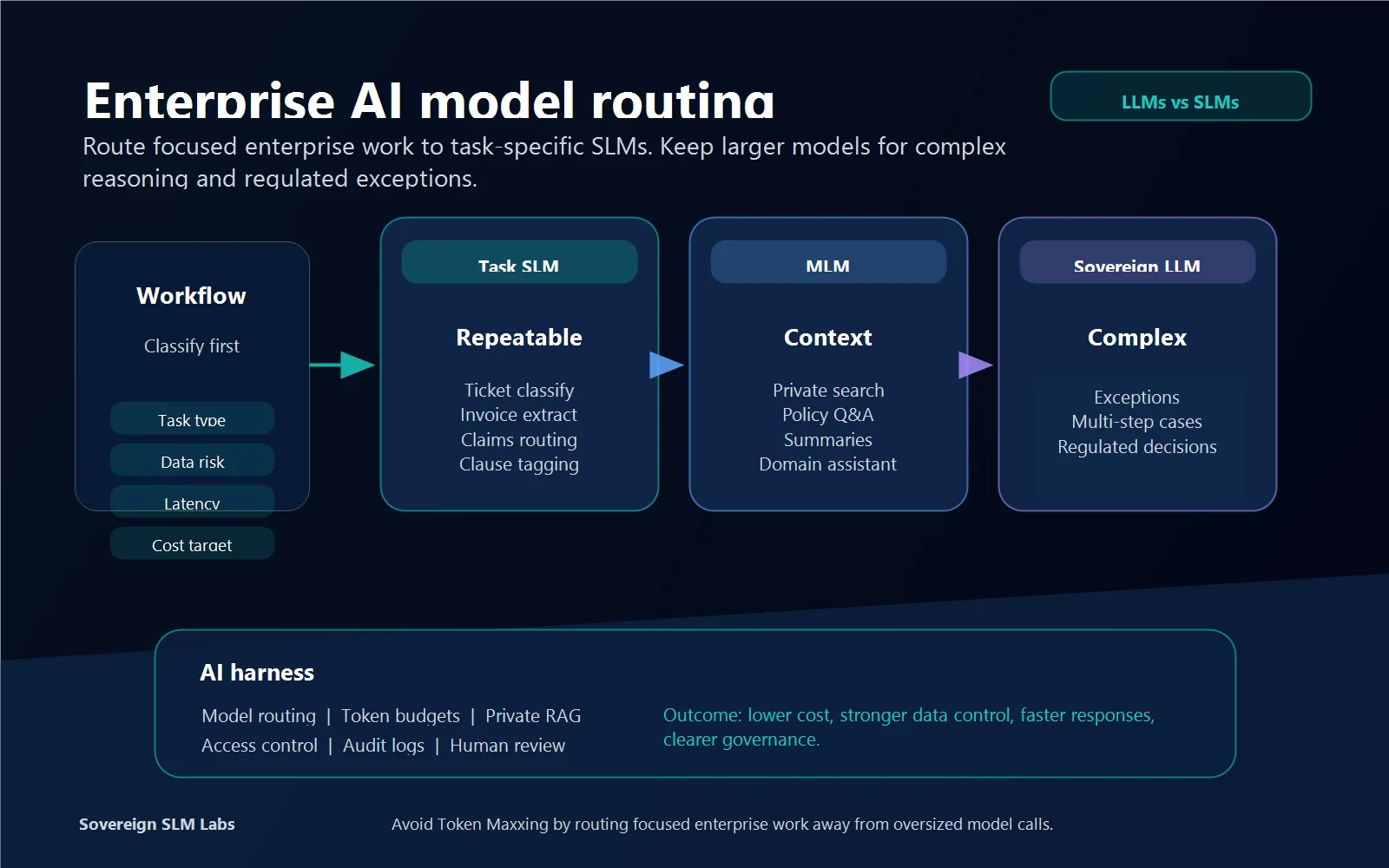
A practical enterprise AI model strategy looks like this:
- Use Task Specific SLMs for high volume repeatable tasks
- Use broader Enterprise SLMs for private internal workflows
- Use Sovereign LLMs for sensitive reasoning workloads
- Use larger LLMs for complex analysis and exceptions
- Use human experts for high risk decisions
This approach supports LLM token cost reduction without reducing the value of AI.
It simply stops the enterprise from using the most expensive model for every request.
Task Specific SLMs Are Not Just Smaller LLMs
It is easy to think of SLMs as smaller versions of LLMs.
That is not the right way to look at Task Specific SLMs.
The value is not only size.
The value is fit.
A Task Specific SLM is valuable because it is aligned to:
- A specific business task
- A specific data pattern
- A specific output format
- A specific process owner
- A specific accuracy requirement
- A specific governance boundary
- A specific cost target
For example, a contract clause detection model does not need to write poetry or solve complex math.
It needs to understand contract language, clause patterns, risk categories and approved output labels.
A claims routing model does not need to explain world history.
It needs to understand claim types, policy terms, document categories and escalation rules.
A retail return classification model does not need broad reasoning.
It needs to classify return reasons accurately and consistently.
This is why Task Specific SLMs can outperform larger models in narrow enterprise workflows.
They do not try to be everything.
They are designed to be useful where the enterprise actually needs them.
Examples of SLMs Enterprises Can Evaluate
Enterprises do not always need to build a Small Language Model from scratch.
In many cases, the better starting point is to evaluate existing SLMs, compact open models or model families that can be adapted for a specific business workflow.
Below are examples that enterprise teams can consider when exploring SLM strategy.
| SLM or Compact Model | Approximate Size | Where It Can Fit |
|---|---|---|
| Microsoft Phi family | Small model family, including mini models | Enterprise assistants, reasoning tasks, coding support, local experiments and private AI workflows |
| Meta Llama 3.2 1B and 3B | 1B and 3B parameters | On device AI, private summarization, retrieval, lightweight agents and edge workflows |
| Google Gemma family | Compact open model family | Private AI applications, text generation, summarization and fine tuned enterprise workflows |
| Qwen small model family | Compact models across multiple sizes | Multilingual workflows, enterprise task tuning, private deployment and domain specific assistants |
| SmolLM family | 135M, 360M and 1.7B parameters | Lightweight local AI, experimentation, edge use cases and low resource environments |
| DistilBERT | Around 66M parameters | Classification, search ranking, sentiment analysis and text understanding tasks |
| MiniLM | Compact transformer model family | Semantic search, embeddings, document matching and retrieval workflows |
| DeBERTa small or base variants | Compact to mid sized language models | Classification, compliance tagging, named entity recognition and document review |
| GLiNER style extraction models | Often small to compact | Named entity recognition, structured extraction, PII detection and schema based parsing |
These examples show why the SLM category is broader than one model family.
Some SLMs are useful for text generation.
Some are better for classification.
Some work well for embeddings and search.
Some are designed for information extraction.
Some can support on device or on prem AI.
Some become powerful only after fine tuning on enterprise data.
For enterprise clients, the key question is not simply which SLM is best.
The better question is:
Which model is the right size, right architecture and right deployment fit for this workflow?
A bank building a KYC review model may need a different SLM than a retailer building a returns classification model. A legal team reviewing contract clauses may need a different model than a support team classifying tickets. A Sovereign LLM program may prioritize private deployment, auditability and data residency more than raw benchmark performance.
This is why Enterprise SLM strategy should always start with the task, not the model.
Enterprise SLMs: Where They Fit in the AI Stack
Enterprise SLMs are Small Language Models designed for business workflows, internal data, domain language and governed deployment.
They are especially useful when the enterprise needs AI that is:
- Private
- Fast
- Cost aware
- Domain aligned
- Easier to evaluate
- Easier to monitor
- Easier to deploy on prem
- Safer for regulated workflows
- More predictable for repeated tasks
Enterprise SLMs may be used across departments such as finance, legal, operations, customer support, compliance, procurement, human resources and IT service management.
They are not meant to replace every LLM.
They are meant to reduce unnecessary dependency on large models.
A good enterprise AI architecture may use:
- Enterprise SLMs for routine internal workflows
- Task Specific SLMs for narrow high volume tasks
- Sovereign LLMs for sensitive and complex reasoning
- External LLMs for approved advanced use cases
- Human experts for judgment heavy work
This creates a balanced model strategy.
It gives the enterprise the flexibility to choose performance, privacy and cost based on the workflow.
Examples of Task Specific SLMs in Enterprise Workflows
Task Specific SLMs can be used across many industries and departments.
Below are practical examples.
Banking and Financial Services
Banks deal with sensitive data, strict compliance rules and high document volume.
Task Specific SLMs can support:
- KYC document review
- Customer request classification
- Compliance checklist validation
- Credit memo summarization
- Policy question answering
- Internal audit document search
- Transaction note classification
- Risk signal tagging
A banking SLM can be deployed inside private AI infrastructure or sovereign AI infrastructure so sensitive data stays within approved systems.
This makes it useful for institutions that need stronger control over data residency, audit logs and model access.
Insurance
Insurance workflows are document heavy and process driven.
Task Specific SLMs can help with:
- Claims intake classification
- Policy document extraction
- Renewal request routing
- Fraud indicator tagging
- Medical document summarization
- Customer support response drafting
- Underwriting document review
- Escalation recommendation
These workflows often involve repeatable patterns.
That makes them a strong fit for Enterprise SLMs because the model can be trained around known forms, policy language and claim categories.
Healthcare and Pharma
Healthcare and pharma organizations need secure AI systems that can handle sensitive information carefully.
Task Specific SLMs can support:
- Patient intake summarization
- Appointment request routing
- Clinical policy search
- Medical document classification
- Prior authorization support
- Claims support
- Internal knowledge assistance
- Regulatory document review
For healthcare use cases, private AI and on prem model deployment may be important because patient data and regulated information need stronger controls.
Retail and Consumer Products
Retail teams often manage high volume interactions across customers, stores, products and supply chains.
Task Specific SLMs can support:
- Order status support
- Return reason classification
- Product question answering
- Customer complaint routing
- Review summarization
- Inventory query assistance
- Store support workflows
- Product catalog enrichment
A retail SLM can reduce support cost while improving response speed and consistency.
It can also reduce the need to send every customer interaction to a large external model.
Manufacturing
Manufacturing environments have operational complexity, safety requirements and technical terminology.
Task Specific SLMs can support:
- Maintenance log analysis
- Equipment issue classification
- Safety procedure search
- Supplier document review
- Quality inspection note summarization
- Operations support
- Training manual assistance
- Root cause tagging
Manufacturing use cases often benefit from private deployment because internal process data, production logs and supplier records may be sensitive.
Legal and Professional Services
Legal and professional services teams need accuracy, confidentiality and traceability.
Task Specific SLMs can support:
- Contract clause detection
- NDA review
- Policy comparison
- Legal request routing
- Matter summary generation
- Compliance review support
- Document tagging
- Obligation extraction
For legal workflows, the goal is not to replace expert judgment.
The goal is to reduce repetitive review, organize information faster and route the right work to the right expert.
Task Specific SLMs and Sovereign LLM Strategy
Sovereign LLM strategy is becoming important for enterprises that want greater control over where AI runs, where data stays and how governance is enforced.
A Sovereign LLM is usually part of a broader private AI or sovereign AI environment where the enterprise has stronger control over infrastructure, data residency, model access and compliance.
Task Specific SLMs fit naturally into this strategy because they can run closer to enterprise data.
They can be deployed in:
- On prem infrastructure
- Private cloud
- Sovereign cloud
- Air gapped environments
- Region specific environments
- Enterprise controlled infrastructure
This is important for industries where sensitive data cannot move freely into public systems.
A Task Specific SLM can help enterprises keep more AI activity inside approved environments.
It can also support:
- Data residency
- Role based access
- Internal governance
- Audit logging
- Security policies
- Approval workflows
- Compliance controls
For enterprise clients, sovereign AI is not only about hosting.
It is about control.
Who controls the data?
Who controls the model?
Who controls access?
Who controls the workflow?
Who controls the logs?
Who controls escalation?
Task Specific SLMs make this control more practical because the model is smaller, focused and easier to place inside governed infrastructure.
Task Specific SLMs and On Prem LLM Strategy
Many enterprises are now exploring on prem LLM deployment.
The reason is simple.
They want AI systems that can run behind the firewall, connect to internal data and support private workflows without unnecessary data exposure.
But an on prem LLM should not become another oversized model used for everything.
A stronger approach is to design a layered model strategy.
That may include:
- Task Specific SLMs for narrow workflows
- Enterprise SLMs for broader internal tasks
- On prem LLMs for sensitive reasoning tasks
- Sovereign LLMs for regulated workloads
- Open source models for private AI use cases
- Larger external LLMs only when approved and necessary
This gives the enterprise flexibility.
It also improves cost control because simple tasks do not have to consume expensive LLM resources.
The important layer here is orchestration.
The system needs to decide which model should handle each task.
For example:
- A claims category can go to a Task Specific SLM
- A sensitive policy question can go to a private LLM
- A complex legal scenario can go to a larger reasoning model
- A high risk decision can go to a human reviewer
This is how enterprises can combine Task Specific SLMs, on prem LLMs and sovereign AI infrastructure into one practical AI operating model.
Build versus Buy Task Specific SLMs
One of the most important enterprise questions is whether to build or buy Task Specific SLMs.
There is no single answer.
It depends on the workflow, data sensitivity, internal capability, business value, timeline and control requirements.
When Enterprises Should Build Task Specific SLMs
Building a Task Specific SLM makes sense when the workflow is strategic, sensitive or highly specific to the organization.
Build may be the better path when:
- The task uses proprietary data
- The workflow is unique to the enterprise
- The organization needs strong data control
- Public models create compliance concerns
- The task has high volume and clear return on investment
- Internal terminology matters
- Accuracy requirements are domain specific
- The enterprise wants long term cost control
- The model needs to run on prem or in sovereign infrastructure
Examples of good build use cases include:
- A bank building a KYC review SLM
- An insurer building a claims routing SLM
- A manufacturer building a maintenance log SLM
- A healthcare organization building a patient intake SLM
- A legal team building a contract clause review SLM
- A retailer building a returns classification SLM
Building gives the enterprise more control.
But it also requires the right foundations.
That includes:
- Clean training data
- Evaluation datasets
- Data governance
- Model testing
- Deployment infrastructure
- Monitoring
- Feedback loops
- Security review
- Ownership from the business process team
Building is worth it when the workflow is important enough and repeated enough to justify the investment.
When Enterprises Should Buy Task Specific SLMs
Buying may be the better option when the use case is common, the timeline is short or the enterprise does not want to own the full model development lifecycle.
Buy may be better when:
- The workflow is common across many companies
- A vendor already has a mature solution
- Time to value matters more than deep customization
- Internal AI engineering capacity is limited
- The task does not require highly sensitive training data
- Configuration is enough
- Managed support is important
- The cost of building is higher than the expected return
Examples of buy friendly use cases include:
- Standard invoice extraction
- Basic support ticket classification
- Generic document summarization
- Common HR policy assistance
- Basic sales email drafting
- Standard knowledge base search
Buying can be faster.
But enterprises should still review:
- Data privacy
- Deployment options
- Vendor lock in
- Integration quality
- Audit visibility
- Security controls
- Long term cost
- Ability to run in private or sovereign infrastructure
A vendor solution may be useful, but it still needs to fit the enterprise architecture.
Build versus Buy Decision Framework
A practical decision framework can help teams avoid overbuilding or buying too casually.
| Decision Factor | Build Task Specific SLM | Buy Task Specific SLM |
|---|---|---|
| Data sensitivity | High | Low to moderate |
| Workflow uniqueness | Highly specific to the enterprise | Common across many organizations |
| Timeline | Longer timeline is acceptable | Fast deployment is needed |
| Internal AI capability | Strong data and AI engineering team | Limited internal AI capacity |
| Control requirement | High control needed | Standard control is acceptable |
| Deployment model | On prem, private cloud or sovereign AI | Vendor managed or configurable private option |
| Cost outlook | High volume justifies investment | Lower volume or faster return needed |
| Compliance need | Strict audit and governance | Standard compliance requirements |
| Customization | Deep customization needed | Configuration is enough |
In many cases, the answer will not be purely build or buy.
The better answer may be hybrid.
An enterprise may use open source models, buy certain components and build Task Specific SLMs for workflows that create the highest value or involve the most sensitive data.
What Enterprises Need Around Task Specific SLMs
A Task Specific SLM is not enough on its own.
It needs the right operating layer around it.
That includes:
- Data preparation
- Evaluation datasets
- Prompt templates
- Private RAG
- Model routing
- Access controls
- Guardrails
- Human review workflows
- Token cost tracking
- Monitoring dashboards
- Audit logs
- Feedback loops
- Continuous improvement
This is where AI harness engineering becomes important.
The model performs the task.
The harness controls the workflow.
The harness decides:
- Which model should run
- Which data the model can access
- Which users are allowed
- Which outputs need review
- Which model should handle exceptions
- Which logs should be stored
- Which cost limits should apply
This is what turns Task Specific SLMs into production ready enterprise AI systems.
Common Mistakes Enterprises Should Avoid
Task Specific SLMs can be powerful, but only if they are designed properly.
Enterprises should avoid these mistakes:
- Choosing a model before defining the workflow
- Training on poor quality data
- Using unapproved or sensitive data without governance
- Ignoring evaluation and testing
- Using an SLM for tasks that need complex reasoning
- Forgetting escalation to larger models or humans
- Treating private deployment as automatic governance
- Not tracking inference cost and latency
- Ignoring model drift as business rules change
- Building a custom model when a vendor solution is enough
- Buying a solution without checking data privacy and deployment fit
The best results come when the enterprise starts with the business process.
Not the model.
The workflow should define the model strategy.
The Future Is a Portfolio of Right Sized Models
The future of enterprise AI will not be one giant model sitting in the center of every workflow.
It will be a portfolio of right sized models.
That portfolio may include:
- Foundation Models for broad capability
- LLMs for complex reasoning
- MLMs for mid complexity workloads
- On prem LLMs for sensitive workloads
- Sovereign LLMs for regulated environments
- Open source models for private AI systems
- Enterprise SLMs for domain specific tasks
- Task Specific SLMs for high volume workflows
- Human reviewers for high risk decisions
The enterprise will need orchestration across all of these.
The winning organizations will know:
- Which model to use
- Where to run it
- What data it can access
- How much it should cost
- When it should escalate
- How it should be monitored
- How it supports governance
Task Specific Small Language Models will be a key part of that future because they match the actual shape of enterprise work.
They are focused.
They are practical.
They are easier to govern.
They are often cheaper to run.
They are better suited for repeated workflows.
They help enterprises scale AI without turning every task into an expensive LLM call.
FAQ: Task Specific SLMs, LLMs vs SLMs and Sovereign LLM Strategy
What is an SLM?
An SLM, or Small Language Model, is a compact language model designed to perform language tasks with lower compute requirements than a large general purpose model.
SLMs are often useful for focused enterprise workflows such as classification, extraction, summarization, internal search, routing and document review.
The main value of an SLM is not only that it is smaller.
The value is that it can be faster, cheaper, easier to deploy privately and easier to govern for repeated business tasks.
What is a Task Specific SLM?
A Task Specific SLM is a Small Language Model designed for one defined workflow.
For example, a company may use a Task Specific SLM for invoice extraction, KYC review, claims routing, support ticket classification, contract clause detection or return reason classification.
It is not meant to answer every question.
It is meant to perform one task with consistency and efficiency.
What is the difference between LLMs vs SLMs?
The simplest difference is scope.
LLMs are broad and powerful. They are useful for complex reasoning, open ended questions, advanced writing, coding and multi step analysis.
SLMs are smaller and more focused. They are useful for repeated workflows, lower latency tasks, cost sensitive use cases and private AI deployment.
In enterprise AI, the question is not whether LLMs or SLMs are better.
The question is which model is right for the task.
What does LLM vs SLM vs MLM mean?
LLM means Large Language Model.
SLM means Small Language Model.
MLM, in this article, means Medium Language Model. It is used as a practical category for models that sit between large general purpose LLMs and compact SLMs.
An enterprise may use all three.
LLMs can support complex reasoning.
MLMs can support mid complexity workflows.
SLMs can support focused and high volume tasks.
Task Specific SLMs can support narrow workflows where consistency and cost control matter.
What is Token Maxxing?
Token Maxxing is an informal term for using more tokens than a task actually needs.
It can happen when enterprises send every task to a large LLM, use long prompts, retrieve too much context, allow agents to loop without limits or generate long outputs for simple questions.
Token Maxxing increases LLM token costs and can make AI programs harder to scale.
Task Specific SLMs help reduce Token Maxxing by routing simple and repeatable work to smaller models.
How do Task Specific SLMs reduce LLM token costs?
Task Specific SLMs reduce LLM token costs by handling narrow tasks without needing large prompts, large context windows or repeated calls to expensive models.
They can often complete focused work with fewer tokens, lower compute and faster inference.
This helps enterprises avoid using a large LLM for every workflow.
Are Task Specific SLMs a replacement for LLMs?
No.
Task Specific SLMs are not a full replacement for LLMs.
They are part of a better enterprise model strategy.
LLMs are still useful for complex reasoning, open ended tasks and high judgment workflows.
Task Specific SLMs are better for repeated, narrow and high volume tasks where cost, speed, privacy and consistency matter.
What are Enterprise SLMs?
Enterprise SLMs are Small Language Models designed or adapted for enterprise workflows.
They may use internal terminology, enterprise documents, domain knowledge, workflow rules and private deployment environments.
Enterprise SLMs can support functions such as finance, legal, compliance, operations, customer support, procurement, healthcare, banking and insurance.
What is a Sovereign LLM?
A Sovereign LLM is a language model deployed as part of a sovereign AI strategy, where the organization has stronger control over data residency, infrastructure, access, governance and compliance.
A Sovereign LLM may run in on prem infrastructure, private cloud, sovereign cloud or a controlled regional environment.
The goal is to give enterprises more control over how AI is deployed and governed.
How do Task Specific SLMs support Sovereign LLM strategy?
Task Specific SLMs support Sovereign LLM strategy because they are easier to deploy inside controlled environments.
They can run closer to enterprise data, support private workflows, reduce dependence on public model APIs and make governance easier.
For regulated industries, this can help with data residency, auditability, access control and compliance.
Can SLMs run on prem?
Yes, many SLMs are suitable for on prem or private cloud deployment because they require fewer compute resources than large models.
This makes them useful for enterprises that want AI behind the firewall, closer to sensitive data and under stronger infrastructure control.
However, on prem deployment alone is not enough.
Enterprises still need access controls, monitoring, audit logs, evaluation, human review and governance.
What are examples of SLMs?
Examples of compact model families or smaller language models include Microsoft Phi, Meta Llama 3.2 1B and 3B, Google Gemma, SmolLM, DistilBERT, MiniLM, DeBERTa small or base variants and extraction focused models such as GLiNER style models.
The right model depends on the task.
A search workflow may need an embedding model.
A document review workflow may need an extraction model.
A support workflow may need a classification model.
A private assistant may need a compact generative model.
Should enterprises build or buy Task Specific SLMs?
Enterprises should build when the workflow is sensitive, strategic, unique or high volume enough to justify the investment.
They should buy when the workflow is common, the timeline is short and configuration is enough.
Many enterprises will use a hybrid approach.
They may buy common capabilities and build Task Specific SLMs for workflows that involve sensitive data, proprietary processes or strong cost saving potential.
What are the best use cases for Task Specific SLMs?
Good use cases usually have high volume, repeated patterns, clear inputs and outputs, available historical data and measurable business value.
Examples include:
- KYC document review
- Claims routing
- Invoice extraction
- Contract clause tagging
- Support ticket classification
- Return reason classification
- Policy Q&A
- Compliance checklist validation
- Maintenance log analysis
- Product catalog enrichment
What is the biggest mistake enterprises make with SLMs?
The biggest mistake is choosing a model before defining the workflow.
The business process should come first.
Enterprises should define the task, data sensitivity, accuracy requirement, output format, escalation path, cost target and governance requirement before choosing or building an SLM.
Conclusion: Task Specific SLMs Make Enterprise AI More Practical
Task Specific Small Language Models are not a replacement for Large Language Models.
They are a practical addition to the enterprise AI stack.
They help organizations reduce high LLM token costs, avoid Token Maxxing, improve response speed, increase privacy, support Sovereign LLM strategy and automate repeatable workflows with more control.
For enterprise clients, the message is simple.
Use LLMs where they are truly needed.
Use Enterprise SLMs where the work is focused, repeated and high volume.
Use on prem LLMs and private AI infrastructure where data control matters.
Use Sovereign LLMs where compliance, residency and governance are critical.
The future of enterprise AI will belong to organizations that build the right model strategy.
Not the biggest model strategy.
The right one.
References
- [1] Microsoft Azure, Phi open models
- [2] Meta AI, Llama 3.2: edge AI and mobile devices
- [3] Google AI for Developers, Gemma models overview
- [4] Hugging Face, SmolLM collection