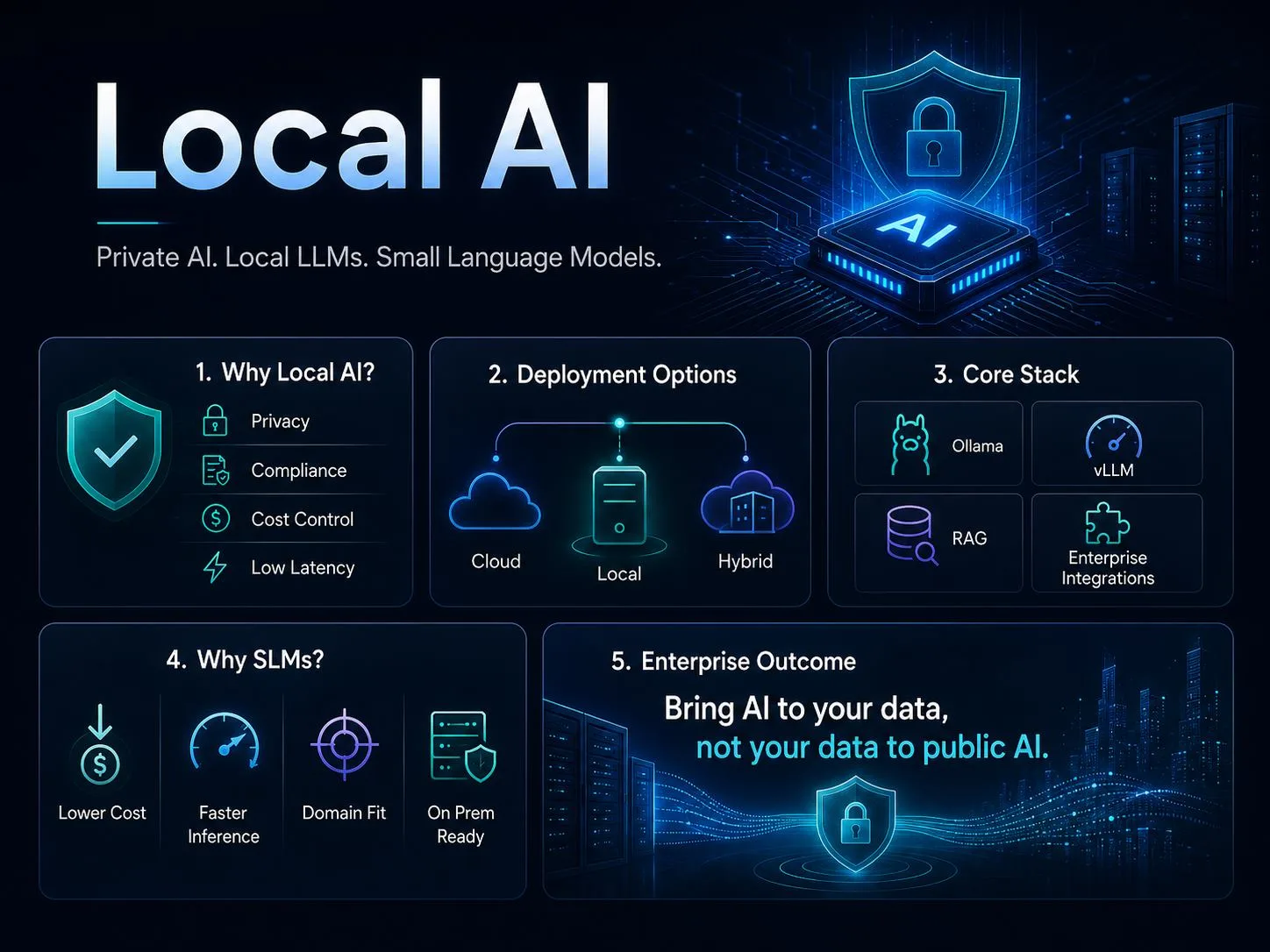
Local AI: Why Enterprises Are Moving Beyond Cloud AI
Artificial Intelligence is no longer an experimental technology. It has become a strategic business capability across enterprise search, document intelligence, customer service, software development, compliance review, and business automation.
The first wave of enterprise AI adoption was largely powered by cloud-hosted Large Language Models. Those services made AI accessible, easy to integrate, and powerful enough for broad experimentation.
But as organizations move from pilots to enterprise-wide deployment, new questions start to matter more:
- How do we protect sensitive business data?
- Can we control escalating AI infrastructure costs?
- How do we meet compliance and data residency requirements?
- Can AI work without depending entirely on public cloud services?
- How do we scale AI securely across the enterprise?
These questions have led to the rise of Local AI.
Instead of sending enterprise data to AI, Local AI brings AI to the enterprise.
What Is Local AI?
Local AI refers to deploying and running AI models inside an organization's own infrastructure rather than relying entirely on public cloud AI platforms.
A Local AI deployment may run on:
- Enterprise data centers
- Private cloud infrastructure
- Dedicated GPU servers
- Employee workstations
- Edge devices
- Air-gapped environments
By processing information within enterprise boundaries, organizations gain greater control over data privacy, security, governance, compliance, operating costs, and performance.
For teams handling confidential information, Local AI is becoming a preferred deployment model because it aligns AI architecture with enterprise data control.
What Is a Local LLM?
A Local Large Language Model is an LLM that runs within an organization's controlled environment instead of being accessed only through a public API.
Common enterprise use cases include:
- Enterprise knowledge assistants
- Contract analysis
- Customer support automation
- Internal search
- Software development copilots
- Technical documentation
- Manufacturing knowledge systems
- HR and policy assistants
Cloud AI: your data travels to the model.
Local AI: the model stays where your data already lives.
For organizations operating in regulated industries, that distinction can reduce security, compliance, and data residency risk.
Why Enterprises Are Adopting Local AI
1. Data Privacy Comes First
Enterprise AI increasingly processes sensitive records: customer data, financial statements, legal contracts, healthcare data, product designs, source code, and internal communications.
Sending this information to external AI services introduces governance and privacy concerns. Local AI minimizes those risks by keeping sensitive information inside approved enterprise environments.
2. Compliance and Data Sovereignty
Organizations in banking, insurance, healthcare, legal services, government, and manufacturing often need to comply with rules around data residency, access controls, auditability, confidentiality, and industry-specific compliance standards.
Local AI gives these organizations more operational control over where data is processed and how AI systems are governed.
3. Predictable AI Costs
Most cloud AI services use consumption-based pricing. As adoption grows, organizations may face rising API costs, budget uncertainty, difficult forecasting, and recurring operational expenditure.
Local AI can shift AI investment toward controlled infrastructure rather than unpredictable per-request pricing.
4. Faster Response Times
Enterprise copilots, manufacturing systems, operational dashboards, and customer support workflows all benefit from reduced latency.
Running inference closer to users and systems can improve performance while reducing dependence on internet connectivity.
5. Greater Customization
Unlike generic cloud services, Local AI enables organizations to build domain-specific assistants, connect directly with enterprise systems, customize workflows, fine-tune business intelligence, and implement organization-specific governance.
Local AI Deployment Options
Every enterprise has different requirements. The right architecture depends on data sensitivity, performance needs, governance requirements, infrastructure maturity, and business value.
| Option | Best For | Advantages | Limitations |
|---|---|---|---|
| Cloud-based LLMs | Early experimentation, non-sensitive workloads, rapid prototypes | Fast deployment, minimal infrastructure, strong general-purpose capability | Sensitive data may leave enterprise boundaries, ongoing API cost, limited deployment control |
| Self-hosted Local LLMs | Sensitive workloads, private infrastructure, controlled deployment | Better privacy, infrastructure control, flexible deployment, lower long-term cost potential | Hardware investment, operational complexity, model serving responsibility |
| Hybrid AI | Enterprises with both sensitive and general-purpose AI workloads | Balances security, flexibility, cost control, and model capability | Requires routing logic, governance, monitoring, and clear workload classification |
Many enterprises will not choose only one deployment path. The practical direction is usually hybrid: sensitive workloads run locally, and general-purpose workloads use cloud models where that is appropriate.
Running Local AI: Ollama vs vLLM
One of the biggest barriers to Local AI used to be deployment complexity. Today, mature tooling has made running Local LLMs significantly easier.
Ollama: The Simplest Way to Get Started
Ollama is popular with developers exploring Local AI because it simplifies model installation, local inference, API access, model management, and experimentation.
It is a strong fit for individual developers, innovation teams, internal prototypes, and proof-of-concept work.
vLLM: Built for Enterprise Scale
As organizations move beyond pilots, they need infrastructure that can serve AI models reliably across multiple users and applications.
vLLM is designed for high-throughput model serving and production inference patterns where GPU utilization, latency, and concurrent request handling matter.
| Tool | Best For |
|---|---|
| Ollama | Local development, demos, rapid experimentation, early proof of concepts |
| vLLM | Production-grade model serving, higher throughput, concurrency, and GPU efficiency |
| Enterprise AI platform | Governance, security, RAG, monitoring, orchestration, access control, and integrations |
Running a Local LLM is only the first step. Enterprise AI requires an ecosystem that combines model serving, retrieval, governance, security, monitoring, evaluation, and business integration.
Challenges of Local AI and How to Solve Them
Infrastructure Costs
Large language models require significant compute resources. Enterprises can reduce that pressure through quantization, GPU optimization, smaller models, efficient serving frameworks, and model routing.
Hallucinations
Language models can generate inaccurate responses. Enterprises should ground answers using Retrieval-Augmented Generation, validation pipelines, approved knowledge sources, confidence checks, and human review where appropriate.
Operational Complexity
Managing AI infrastructure introduces responsibilities around security, updates, monitoring, scaling, access control, and incident response. Standardized deployment frameworks and centralized AI governance reduce operational overhead.
Enterprise Integration
AI delivers the greatest value when connected to ERP, CRM, document repositories, knowledge bases, ticketing platforms, identity providers, and approval workflows.
These integrations are often where enterprises realize the highest business impact.
Why Small Language Models Are the Future of Local AI
One of the biggest misconceptions about enterprise AI is that bigger models always produce better business outcomes.
In reality, many enterprise use cases do not require trillion-parameter models. Many are narrow, repeatable, measurable, and tied to a known business process.
This is where Small Language Models shine.
SLMs are optimized to deliver high-quality results for targeted business tasks while consuming fewer resources.
Benefits of SLMs
- Lower infrastructure costs for focused workloads
- Faster inference for interactive applications
- Better fit for domain-specific tasks
- On-premises and private cloud readiness
- Stronger alignment with private AI requirements
- Practical deployment in edge and air-gapped environments
Rather than replacing large models, SLMs complement them by providing specialized, efficient intelligence where it matters most.
The Sovereign SLM Labs Approach to Local AI
At Sovereign SLM Labs, we believe the future of enterprise AI is not about choosing between cloud and local models. It is about building the right AI architecture for each business.
Our approach combines:
- Secure Local AI deployments
- Enterprise-grade Small Language Models
- Retrieval-Augmented Generation
- Private AI infrastructure
- AI governance and guardrails
- Enterprise application integration
- Scalable deployment architectures
- Model routing across SLMs, local models, and larger LLMs
The result is AI that is secure, cost-effective, compliant, and tailored to the organization's workflows.
Final Thoughts
The conversation around enterprise AI is evolving.
Organizations are no longer asking only, "Can AI help us?"
They are asking how to deploy AI securely, protect sensitive data, control costs, and scale responsibly.
Local AI provides the foundation to answer those questions.
By combining Local LLMs, Small Language Models, Retrieval-Augmented Generation, and enterprise-grade governance, organizations can build AI systems that are not only intelligent but also secure, efficient, and ready for production.
The future of enterprise AI is not simply bigger models. It is smarter architectures.
For many organizations, that future begins with Local AI.
FAQ: Local AI, Local LLMs, Private AI, and SLMs
What is Local AI?
Local AI means deploying and running AI models inside an organization's controlled infrastructure instead of relying entirely on public cloud AI platforms.
Local AI may run in data centers, private cloud, dedicated GPU servers, workstations, edge devices, or air-gapped environments.
What is the difference between Local AI and cloud AI?
Cloud AI typically sends prompts, context, and outputs through a public cloud endpoint.
Local AI keeps inference closer to enterprise data and infrastructure, which can improve privacy, governance, latency, compliance, and cost predictability.
What is a Local LLM?
A Local LLM is a Large Language Model that runs within an organization's controlled environment instead of being accessed only through a public API.
It can support private assistants, internal search, contract analysis, support automation, software copilots, and regulated knowledge workflows.
When should an enterprise choose a Local LLM?
Enterprises should consider a Local LLM when workloads involve sensitive data, strict access controls, data residency requirements, offline needs, low latency, or predictable high-volume usage.
Many organizations use a hybrid model where sensitive workflows run locally and less sensitive general-purpose work uses cloud AI.
What are the benefits of Small Language Models?
Small Language Models can reduce infrastructure cost, improve response speed, support private deployment, and fit domain-specific enterprise tasks.
SLMs are especially useful for focused workflows such as classification, extraction, routing, policy Q&A, and document intelligence.
Is Ollama suitable for enterprise deployments?
Ollama is well suited for local development, experimentation, demos, and proof-of-concept work because it simplifies model setup and local inference.
Production enterprise deployments usually need additional layers for governance, access control, monitoring, security, scaling, RAG, evaluation, and enterprise integration.
What is vLLM and how is it different from Ollama?
vLLM is a model serving framework designed for high-throughput, memory-efficient inference.
Ollama is often used to simplify local model experimentation. vLLM is more commonly considered for production serving where throughput, latency, concurrency, and GPU utilization matter.
How does Retrieval-Augmented Generation improve Local AI?
Retrieval-Augmented Generation connects a language model to approved enterprise knowledge sources.
In Local AI, RAG helps ground answers in internal documents, policies, tickets, contracts, and knowledge bases while keeping sensitive retrieval and inference inside controlled infrastructure.
Which industries benefit most from Local AI?
Industries with sensitive data, regulated workflows, or strong data residency needs benefit most from Local AI.
Common examples include banking, insurance, healthcare, legal services, government, manufacturing, energy, telecom, and software teams handling source code or confidential intellectual property.
Is Local AI more secure than cloud AI?
Local AI can reduce some data exposure and residency risks because sensitive information can remain inside controlled enterprise environments.
It is not automatically secure. Enterprises still need identity controls, network security, encryption, monitoring, logging, evaluation, human review, and governance.
References
- [1] Ollama, Quickstart documentation
- [2] vLLM, vLLM documentation
- [3] Meta AI, Llama 3.2 edge and mobile models
- [4] Google AI for Developers, Gemma model documentation
- [5] Mistral AI, Mistral AI documentation
- [6] Qwen, Qwen documentation