Enterprise AI advisory

AI Strategy & Architecture

Make AI work for your business, not the other way around.

Private, secure and sustainable enterprise AI, designed around your workflows and your requirements.

Discuss your AI strategy
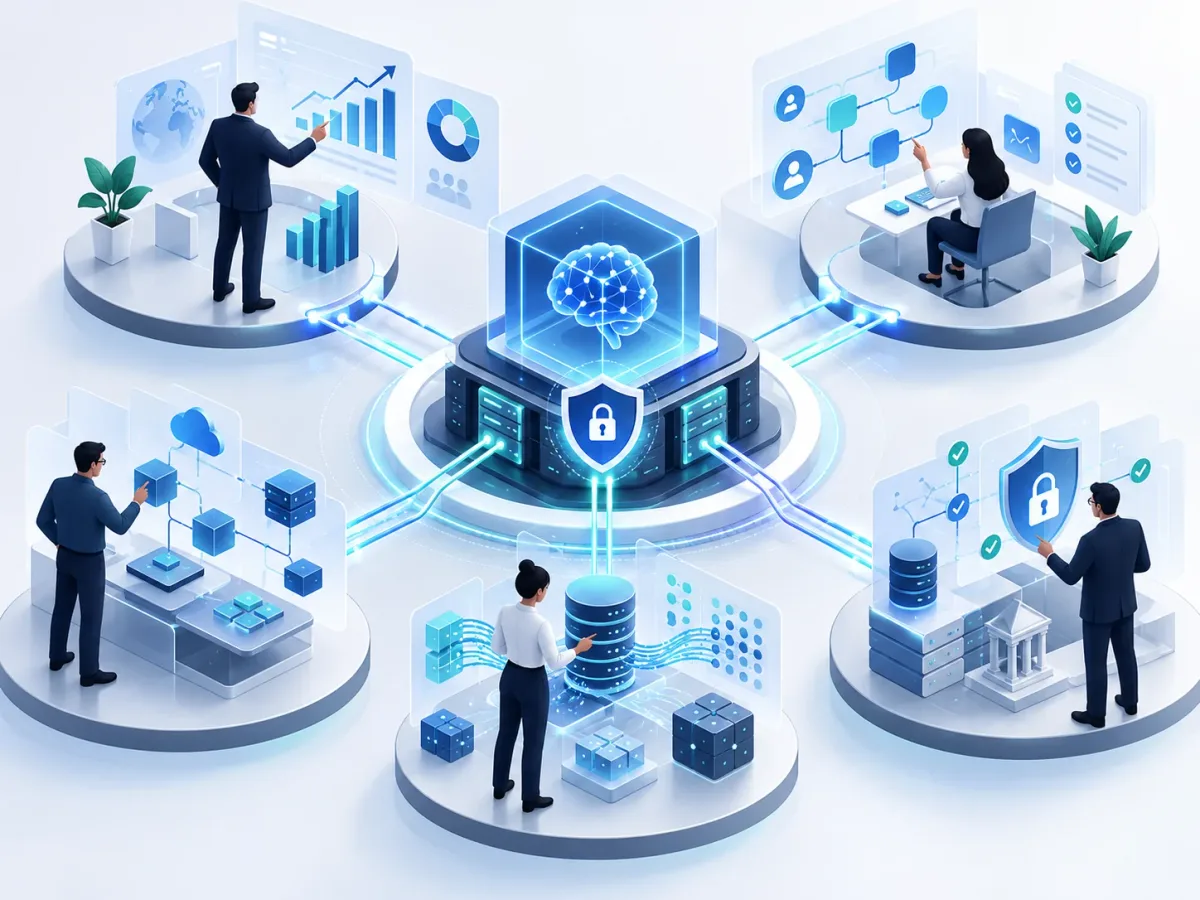
Business priorities, workflows, infrastructure, data and governance connected around private AI

The starting point

Make AI work for your business, not the other way around.

Enterprises are under pressure to adopt AI. New models appear every few weeks, teams are experimenting with copilots and agents, and almost every function has ideas for what AI could do.

The difficult part is turning that interest into something the business can rely on.

At Sovereign SLM Labs, we help organizations make the important decisions before they commit to major AI investments. Which business problems are worth solving? What data can AI use? Should a task run on a Small Language Model (SLM), a larger model, conventional software or a combination? How should the solution connect to existing applications? Who controls what an AI agent is allowed to do?

We bring business leaders, functional teams, enterprise architects, data specialists and security teams into the same conversation. The result is a practical AI strategy backed by an architecture that can be built, governed and operated over time.

Our focus is private, secure and sustainable enterprise AI, designed around your workflows and your requirements.

Discuss your AI strategy with us

Beyond the demo

Why AI initiatives struggle after the first successful demo

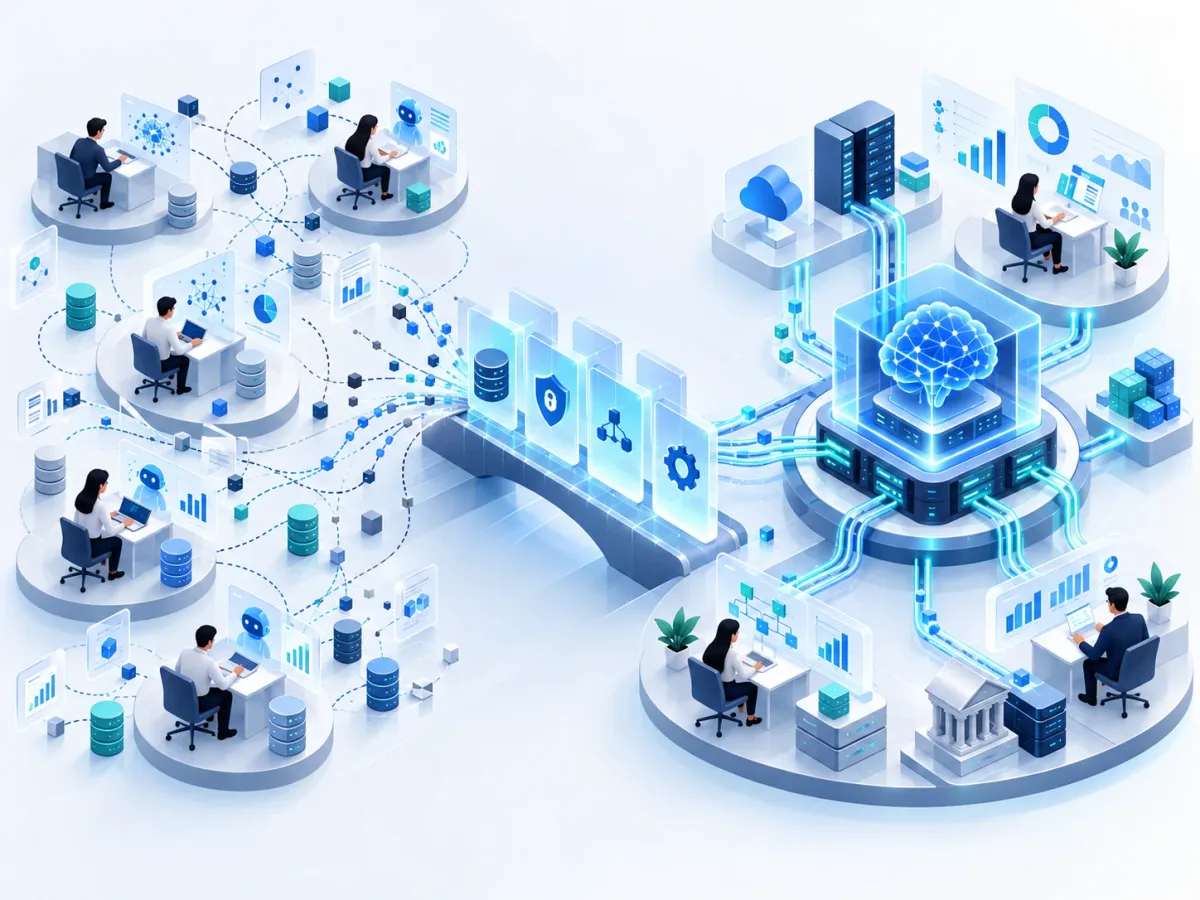
Disconnected AI pilots connected through shared data, security and operational controls
Disconnected AI pilots connected through shared data, security and operational controls.

A proof of concept can show what is possible. It rarely tells you everything you need to know about running AI in production.

A business team may want faster decisions, while the technology team is focused on deployment. Operations teams understand the exceptions, but those exceptions never make it into the design. Security is brought in late, after documents have already been indexed or a model has been connected to sensitive systems.

This often leads to the same problems:

  • Several teams purchase or build similar AI tools without a shared plan.
  • Promising pilots stall because the data is incomplete, inconsistent or difficult to access securely.
  • The model performs well in a demonstration but struggles with real documents, edge cases and changing business rules.
  • AI agents receive more access than they need, with limited visibility into the actions they take.
  • Inference costs, integration effort and support requirements become clear only after implementation.
  • No one has clear ownership of model performance, approvals, incidents or long-term improvements.

We address these questions during strategy and architecture, when they are still relatively inexpensive to solve. The objective is not to slow innovation. It is to give good ideas a realistic path to production.

Shared priorities

Connecting business priorities with technical decisions

AI adoption works best when business, functional and technology teams understand what each other needs.

Business leaders know the outcome they want: lower operating cost, faster turnaround, better service, reduced risk or more capacity for growth. We turn those goals into measurable use cases, with a clear baseline and a way to judge success.

Functional teams know how the work actually gets done. They understand policies, exceptions, approval chains and where human judgment matters. We capture that knowledge before deciding what AI should automate, recommend or leave to people.

Technology, data and security teams know what can be supported safely. We translate business and functional needs into system integrations, data contracts, model requirements, access controls, infrastructure choices, testing and operational responsibilities.

Instead of handing a vague use case from one team to another, we build a shared understanding of the complete workflow:

Business goal → Process and decision rules → Data and access requirements → AI and application design → Evaluation → Production operations

That alignment matters just as much as the choice of model. It prevents teams from building an impressive solution that solves the wrong problem or cannot fit into the enterprise environment.

What we do

Our AI Strategy & Architecture services

01. Private AI Strategy & Readiness

Understand where you stand before deciding where to invest.

We assess the organization's readiness across business processes, enterprise data, applications, infrastructure, security, people and governance.

The assessment examines questions such as:

  • Which use cases have an identifiable business owner and a measurable outcome?
  • Is the information needed by AI accurate, current, accessible and appropriately classified?
  • What restrictions apply to confidential data, personally identifiable information and regulated records?
  • Which existing platforms and teams can support deployment and operations?
  • What AI policies, approval processes and skills are already in place?

We also review build-versus-buy choices, private AI deployment options, data residency, vendor dependencies and the AI operating model. The output is a realistic picture of the gaps to close and the opportunities worth pursuing first.

02. AI Use-Case Discovery & Prioritization

Choose use cases because they make business sense, not because they make a good demo.

We work with stakeholders to identify opportunities across knowledge management, document processing, decision support, customer and employee operations, compliance, analytics and workflow automation.

Each use case is evaluated for business impact, data readiness, integration effort, process complexity, security and regulatory risk, user adoption and total cost of ownership.

Importantly, we do not assume every problem needs generative AI. A deterministic rules engine may be better for calculations and policy checks. Traditional machine learning may suit forecasting or classification. Secure Retrieval-Augmented Generation (RAG) may be appropriate for knowledge-heavy work, while an AI agent may be useful when a workflow genuinely requires reasoning across tools and systems.

You receive a prioritized use-case portfolio, success measures and a clear recommendation on what to validate first.

03. Enterprise AI Architecture & Model Strategy

Design the whole system, not just the model call.

A production AI solution depends on how applications, data, retrieval pipelines, models, agents, identity services and operational controls fit together.

We create enterprise AI reference architectures and evaluate the options for model hosting, APIs, orchestration, storage, security, monitoring and integration with current systems.

Our model strategy considers SLMs, LLMs, open-weight and proprietary models, embedding models, rerankers and multi-model routing. We compare them against task quality, latency, throughput, privacy requirements, licensing, infrastructure needs and long-term cost.

For example, a compact model may be enough for high-volume document classification. A different model may be needed for complex synthesis or exception handling. Some workflows may combine AI with deterministic validation and human approval.

The right answer comes from testing models against your actual tasks, rather than selecting one based on popularity or parameter count.

04. Private & Sovereign AI Infrastructure Strategy

Keep control of the data, models and workloads that matter most.

We help determine where AI should run and what level of infrastructure control is appropriate. Depending on business needs, the architecture may use on-premises infrastructure, a private cloud, a dedicated virtual private cloud (VPC), a hybrid environment or edge inference.

We review GPU and compute requirements, networking, identity, secrets management, encryption, key ownership, tenant isolation, private endpoints, capacity planning, high availability and disaster recovery.

We also look at data movement, cross-border processing restrictions, resilience, licensing and the ability to move models or workloads without major rework.

Sovereignty is not simply a hosting label. It is about having clear authority over where information is processed, who can access it, how models are operated and which external dependencies remain.

05. AI Modernization & Transformation Roadmaps

Move from isolated experiments to a capability the enterprise can reuse.

We build phased roadmaps that connect use-case delivery with shared AI capabilities. These can include enterprise knowledge services, identity-aware retrieval, model gateways, agent execution controls, evaluation frameworks and monitoring.

The roadmap identifies what can be piloted quickly, what requires architectural groundwork and what must be in place before broader deployment.

Each phase has business owners, dependencies, investment considerations, measurable outcomes and agreed release criteria. The plan also covers team capability, change management, support, governance and continuous improvement after launch.

From design to operations

The architecture behind enterprise-ready AI

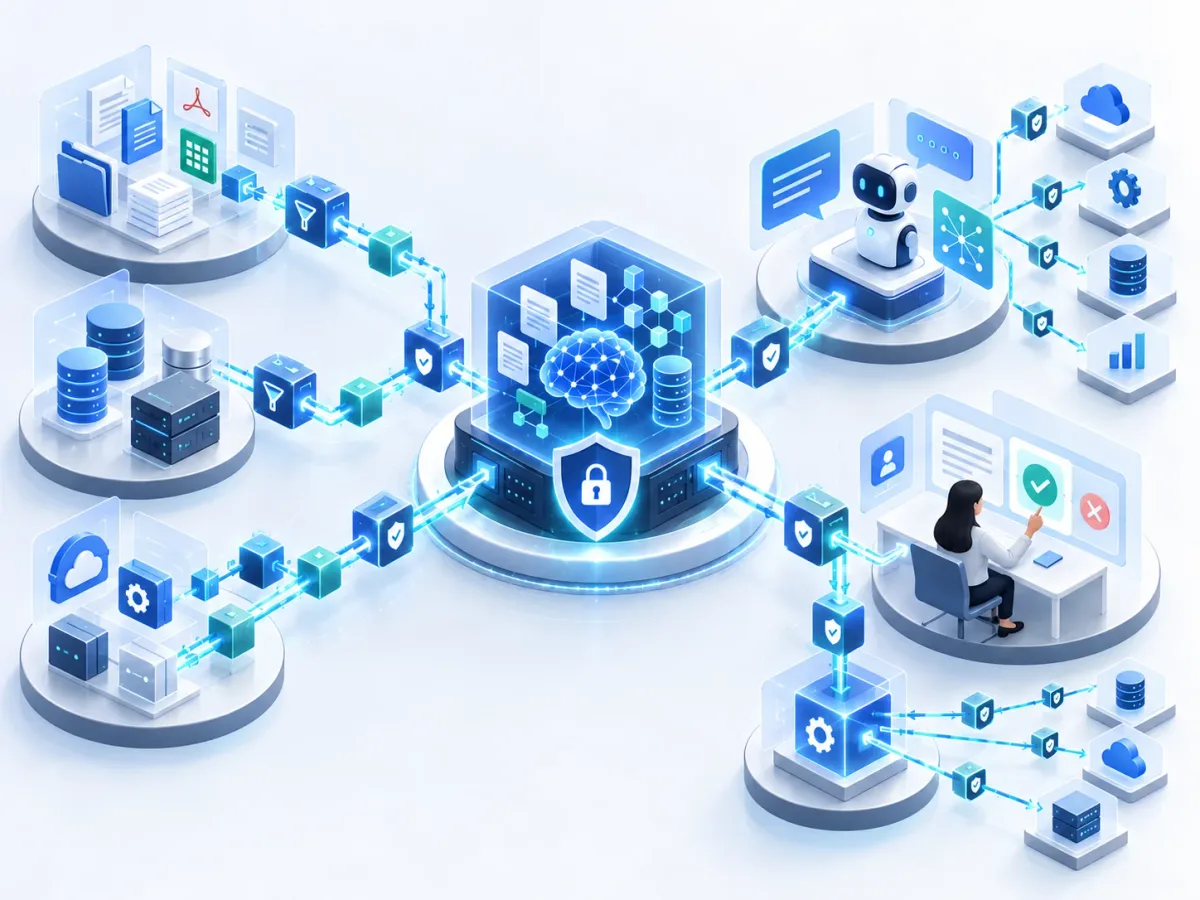
Enterprise documents and systems connected to secure retrieval, AI agents and human approvals
Enterprise documents and systems connected to secure retrieval, AI agents and human approvals.

AI architecture is where ambitious use cases meet real-world constraints. Our strategy work goes into the engineering decisions that determine whether an application will be secure, accurate, maintainable and affordable.

Secure RAG and enterprise knowledge systems

When an AI assistant needs to answer questions from internal documents, a prompt alone is not enough. The system needs a reliable way to find the right information, confirm that the user may see it and make the answer traceable to its source.

We design Secure RAG architectures covering document ingestion, parsing, chunking, metadata, embeddings, vector databases, hybrid search, reranking, contextual retrieval and source citations.

The design also addresses document-level access control, RBAC, ABAC, tenant isolation, permission-aware retrieval, data freshness, content versioning and auditability.

A user should not gain access to a confidential document simply because an AI assistant has indexed it. Authorization has to carry through to retrieval and to any downstream tools.

We include testing for retrieval accuracy, grounded answers, unsupported claims, prompt injection, sensitive-data leakage and difficult real-world questions.

Model engineering and intelligent model selection

A model that scores well on public benchmarks may not be the best model for your particular workload.

We define task-specific evaluation sets and compare candidates on accuracy, reliability, p95 latency, throughput, privacy and cost per successful task.

Where there is a clear reason to do so, the model strategy may include prompt and context engineering, supervised fine-tuning, LoRA or QLoRA, quantization, distillation, inference optimization, caching and model routing.

We also assess when an SLM should handle routine, high-volume tasks and when a larger model is justified. In some situations, a governed multi-model design offers the best balance of capability and cost.

Our principle is straightforward: use the smallest practical model that reliably meets the business requirement, while keeping a clear path for more demanding tasks.

AI agents and harness engineering

Giving an LLM access to tools does not automatically make it a dependable enterprise agent.

An AI agent needs a reliable operating environment around the model. This is the role of agent harness engineering.

We design the controls around an agent's instructions, working context, memory, tool access, execution state, validation, retries, limits and human approvals. We also consider agent orchestration, structured outputs, deterministic checkpoints, exception queues, tracing and recovery from failed actions.

Tools are exposed through approved interfaces, with least-privilege permissions and clear constraints on what an agent can read, write or initiate. Where appropriate, Model Context Protocol (MCP) can provide a standard interface to authorized enterprise capabilities.

For higher-risk actions, the design can require explicit approval before an agent changes records, triggers payments, sends communications or takes other consequential steps.

We do not recommend multi-agent systems simply because they are fashionable. They add coordination and operational complexity, so they should be used when the workflow actually benefits from them.

Enterprise integration and workflow orchestration

AI delivers more value when it works within established business processes.

We plan integrations with ERP, CRM, HRMS, document management systems, data warehouses, ITSM platforms, internal APIs and industry-specific applications. This includes API contracts, event-driven architectures, service boundaries, error handling and the treatment of inconsistent or incomplete source data.

An important distinction is whether AI is providing information, recommending an action or making a change in a system of record. Each needs a different level of authorization, validation and auditability.

For workflows involving financial calculations, regulatory decisions or contractual obligations, AI can assist with interpretation and document handling while deterministic checks and approved users retain control of critical decisions.

LLMOps, AgentOps and production architecture

AI systems change after they go live. Models get upgraded. Content changes. New integrations are added. User behavior reveals new edge cases.

We design the operational foundation to manage that change, including versioned prompts and policies, model registries, automated evaluations, deployment controls, CI/CD, rollback, logging, tracing, drift monitoring and incident response.

The infrastructure strategy may include containerized model serving, GPU scheduling, Kubernetes, model gateways, secrets management, autoscaling and private networking, depending on scale and environment.

LLMOps and AgentOps also need visibility into answer quality, retrieval performance, tool actions, latency, token usage and cost. Without those controls, it becomes difficult to know when a system is deteriorating or whether an agent is still operating within its intended boundaries.
Control by design

Governance should shape the design from day one

It is difficult to retrofit governance into an AI system after it has been connected to sensitive data and enterprise applications.

We work governance into architecture decisions at the beginning. That means defining who owns the use case, what the system is permitted to do, which data it can use, how its performance will be measured and when a human must step in.

Areas we cover include:

  • Security and privacy: identity management, least-privilege access, encryption, data minimization, retention, segregation of duties and private deployment boundaries.
  • Agent and workflow controls: tool permissions, action limits, transaction thresholds, human-in-the-loop approval, safe failure paths and escalation rules.
  • Model evaluation and assurance: representative test datasets, groundedness, retrieval quality, hallucination checks, adversarial testing, prompt-injection resilience and regression testing.
  • Auditability and accountability: model and prompt versions, source references, tool execution records, approvals, operational logs and traceability appropriate to the workflow.
  • Lifecycle governance: changes to models and datasets, periodic reassessment, incident management, risk acceptance and retirement or replacement of systems that no longer meet requirements.

Where relevant, we use established guidance such as the NIST AI Risk Management Framework, ISO/IEC 42001 and OWASP guidance for LLM and GenAI applications, alongside applicable industry rules.

The aim is not to produce policies that sit on a shelf. It is to make responsible behavior part of how the system actually works.

Long-term value

An AI strategy that remains sustainable after the pilot

Speed matters, but a quick pilot is only useful if there is a credible way to maintain and scale it.

A sustainable AI strategy looks beyond the cost of a model API call. It considers total cost of ownership (TCO), infrastructure and GPU utilization, integration effort, inference cost, cost per completed workflow, operational support, security overhead and future change.

It also considers whether the architecture uses more computing capacity than the workload needs, whether teams are duplicating capabilities and whether the organization can switch models without rebuilding everything around them.

We generally favor reusable services, right-sized models, clearly bounded automation and portable interfaces. We plan for observability, governance and adoption instead of treating those as work to be completed after launch.

The goal is an AI capability that can evolve with your business and the technology landscape, without losing control over cost, data or decision-making.

Industry context

Industry experience shapes the architecture

A strong architecture must reflect the requirements of the industry in which it operates. The data, workflows, controls and definition of a successful outcome can vary significantly.

Banking, financial services and hedge funds

Private research assistants, due diligence, KYC and AML support, investment-document intelligence, regulatory knowledge, compliance workflows and evidence management. Architectures must account for confidentiality, traceability, permissions and review before consequential actions.

Aviation and airlines

Operational knowledge assistants, SOP and maintenance-document retrieval, disruption-management support and workflow integration around Passenger Service Systems (PSS), Departure Control Systems (DCS), Global Distribution Systems (GDS) and related operational platforms. Reliability and controlled access are central to the design.

Telecommunications and critical infrastructure

Cybersecurity evidence collection, network knowledge assistants, incident support, technical runbooks and controlled retrieval across sensitive infrastructure documentation. Security boundaries, service availability and audit trails deserve particular attention.

FMCG, retail and manufacturing

Distributor-claim reconciliation, commercial-policy interpretation, product and pricing knowledge, supplier documents, quality investigations and AI-assisted ERP workflows. Many use cases work best when AI handles unstructured information while deterministic engines perform calculations and validation.

Insurance

Policy and coverage knowledge, claims-document intelligence, triage support, exception analysis and review workflows. The architecture should preserve clear human accountability for decisions that affect customers.

Healthcare and pharmaceuticals

Controlled knowledge retrieval, administrative document workflows, research and regulatory evidence, and privacy-aware internal assistants. Data protection, clinical or professional oversight and validation requirements influence the architecture from the start.

Real estate and property management

Lease abstraction, asset and property knowledge, tenant-service assistance, portfolio reporting and governed access to operational and financial systems.

Government, legal and professional services

Confidential knowledge systems, document review, policy retrieval, multilingual service support and traceable workflows where accuracy, access rights and auditability matter.

These are examples of the problems we help organizations assess and design for. The appropriate solution depends on the use case, available data and applicable obligations.

How we work

Our approach: From an AI idea to a workable plan

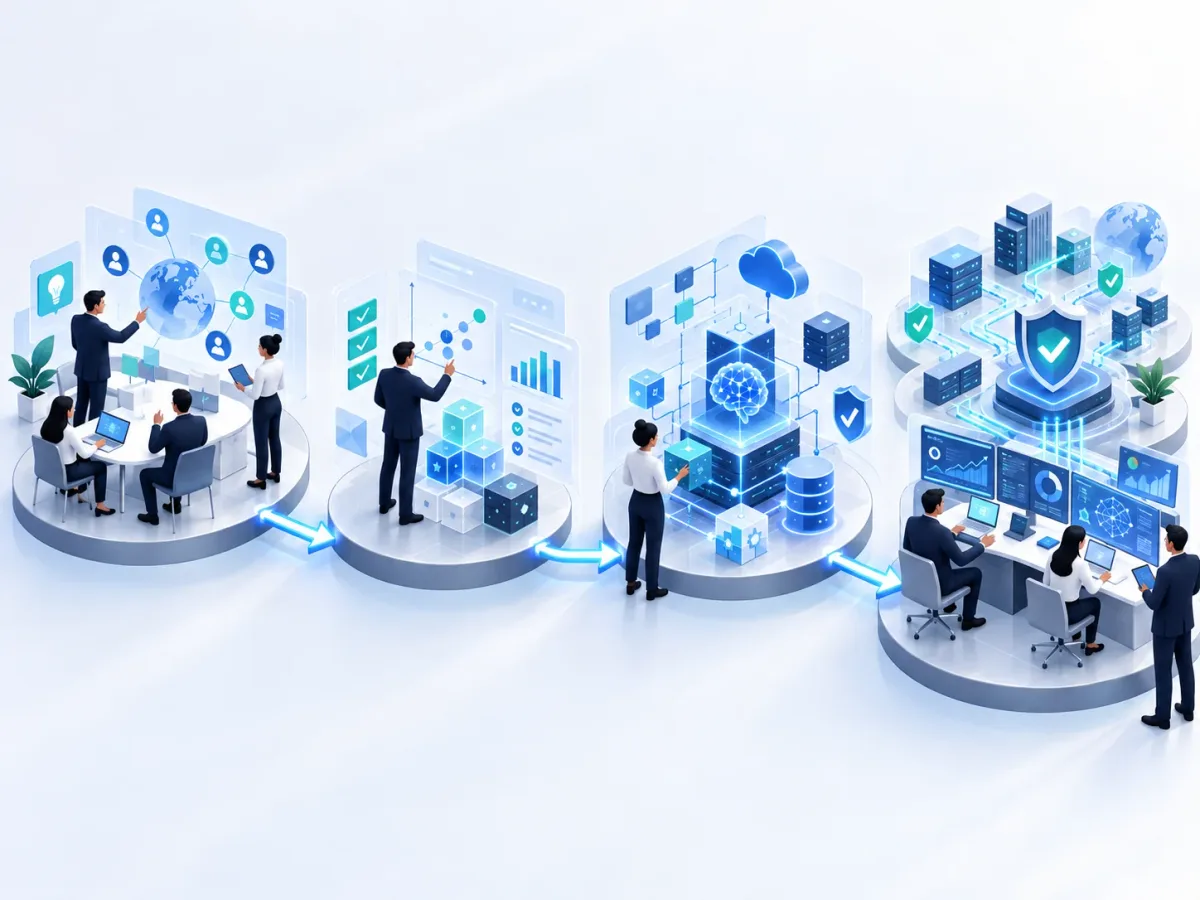
From stakeholder discovery and use-case prioritization to private AI architecture and governed operations
From stakeholder discovery and use-case prioritization to private AI architecture and governed operations.

1. Understand the business and the workflow

We start with the people responsible for the outcome and the teams who know the process. We look at current performance, pain points, exceptions, data sources and decision rights. The goal is to agree on the problem before selecting technology.

2. Assess readiness and evaluate options

We assess the underlying data, applications, integration constraints, infrastructure, security requirements and operational ownership. We compare technology options, including cases where conventional automation is the better choice.

3. Design and validate the target architecture

We define the model, retrieval, agent, integration and infrastructure patterns needed for the chosen use cases. We also specify security controls, evaluation criteria, performance expectations and the tests needed to validate assumptions.

4. Build a phased roadmap for delivery and governance

We identify what to deliver first, which shared capabilities should be built, what each phase depends on and how teams will support the solution. The roadmap includes owners, decision points, measurable outcomes and a path from pilot to production.

What you receive

Depending on the engagement scope, deliverables can include:

  • AI readiness assessment covering data, processes, technology, people and governance.
  • Prioritized use-case portfolio with business value, feasibility, risk and success measures.
  • Enterprise AI architecture blueprint covering systems, models, data flows, deployment and integration choices.
  • Secure RAG and agent design with identity, retrieval permissions, tool access, approvals and audit requirements.
  • Model evaluation strategy with benchmarks for quality, latency, privacy and cost.
  • AI governance and operating model defining controls, ownership and lifecycle responsibilities.
  • Transformation roadmap with phases, dependencies, investment considerations and release criteria.

Our perspective

Why Sovereign SLM Labs?

We approach AI from both sides of the table. We understand that a business leader needs an outcome, while an enterprise architect needs a design that can survive a security review and a production incident.

Our work connects those priorities. We go beyond broad strategy presentations into the architecture details: private model deployment, Secure RAG, model engineering, agent harnesses, enterprise integrations, access control, evaluation and ongoing operations.

We are not committed to placing a large language model at the center of every problem. Sometimes a focused SLM is the right choice. Sometimes an existing enterprise platform or a deterministic workflow is better. Often, the most dependable solution uses several approaches together.

We help you make those decisions with a view to business value, control and long-term sustainability.

Your questions

Frequently asked questions

What does an enterprise AI strategy cover?

An enterprise AI strategy identifies where AI can create measurable value, which use cases should come first, what data and skills are needed, and how the organization will manage risk and adoption. The architecture turns that strategy into a design for models, systems, integrations, security and operations.

What is the difference between private AI and sovereign AI?

Private AI generally refers to AI deployed or operated within restricted environments with controlled access to data and models. Sovereign AI places additional emphasis on organizational or jurisdictional control over infrastructure, data processing, models and dependencies. The exact requirements depend on the enterprise and the regulations it operates under.

How is Secure RAG different from standard RAG?

Secure RAG includes the retrieval and grounding capabilities of RAG, with stronger controls over what content can be indexed, searched and shown. It typically requires identity-aware retrieval, source-document permissions, tenant isolation, auditability and protection against prompt injection and data leakage.

What is harness engineering for AI agents?

Harness engineering is the design of the system around an AI model that makes an agent usable in a real workflow. It includes instructions, context, memory, tools, permissions, execution rules, validation, error handling, monitoring and human approvals. These controls determine what an agent can do and how its behavior is checked.

Should enterprises use SLMs or LLMs?

There is no universal answer. SLMs can work well for focused tasks where speed, privacy and cost matter. Larger models may be appropriate for more complex reasoning. Many organizations benefit from testing several models and routing tasks based on quality, sensitivity, latency and cost requirements.

Can AI agents safely connect to enterprise systems?

Yes, if access and actions are properly designed and controlled. Agents should use approved APIs, have only the permissions they need, operate within defined limits and request human approval for sensitive actions. Logging, evaluation and failure recovery are also important.

How do you measure the ROI of an AI initiative?

Start with a baseline for the existing process. Measure outcomes such as time saved, resolution quality, human review effort, error rates, throughput and adoption. Compare the value created with the full cost of infrastructure, models, integrations, support and governance, not just the initial development cost.

Can we adopt AI without replacing our existing business applications?

In many cases, yes. AI can be integrated with existing ERP, CRM, document and industry platforms through APIs, retrieval services and controlled workflows. Modernization should be considered where current systems limit security, data access, performance or business value.

Start a conversation

Let's build an AI strategy you can actually execute

If you are evaluating private AI, planning an enterprise AI platform or trying to move beyond disconnected pilots, we can help you work through the business priorities and the architecture decisions together.

Start with the use cases. Make the trade-offs visible. Put governance in the design. Then build with confidence.

Talk to Sovereign SLM Labs

Explore our other services