LLM Cost Optimization · Enterprise SLMs · Private AI Economics
LLM Cost Optimization: How Enterprises Can Control AI Token Costs at Scale
Published · Sovereign SLM Labs
Enterprise AI adoption is growing fast, but uncontrolled LLM token costs can quietly damage ROI. This guide covers LLM cost optimization strategies for enterprises, including model routing, SLMs, open-source models, private infrastructure, AI harness engineering, and AI FinOps.
Introduction: Why LLM Cost Optimization Matters Now
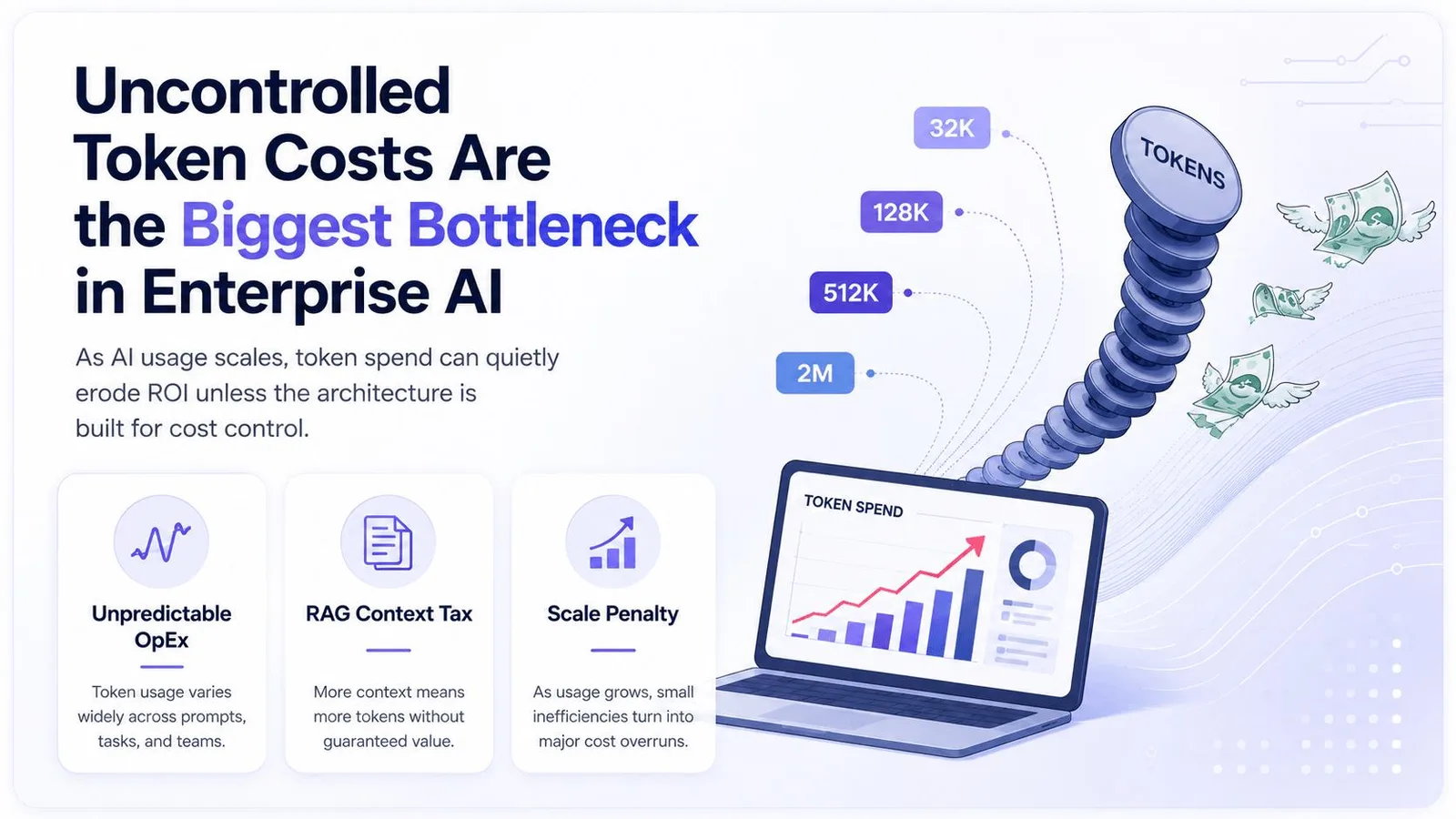
Every enterprise wants to use AI right now.
Teams want AI assistants for:
- Customer support
- Sales outreach
- Coding
- Finance workflows
- Legal reviews
- HR queries
- Knowledge search
- Document processing
- Internal operations
That excitement makes sense.
AI can save time.
AI can reduce repetitive work.
AI can help employees move faster.
AI can improve customer experience.
But there is one problem that many companies are still underestimating.
Token costs can spiral out of control.
A good example is Uber. Reports say Uber exhausted its 2026 AI budget in just four months after Claude Code spread across around 5,000 engineers faster than expected. [1]
That is not just an Uber problem.
It is a warning for every enterprise.
Because once AI moves from a few pilots to thousands of employees and workflows, the cost model changes completely.
Why LLM Token Costs Are Different From Normal Software Costs
Traditional software costs are usually easier to predict.
You pay for:
- Licenses
- Seats
- Cloud usage
- Storage
- Support
- Infrastructure
AI costs are different.
With AI, every interaction can create a cost.
You pay when the model:
- Reads a prompt
- Processes a document
- Looks at retrieved context
- Generates an answer
- Calls a tool
- Retries a task
- Summarizes long files
- Runs an agentic workflow
- Uses reasoning tokens
- Handles multiple steps in the background
That means the cost is not only based on how many people use AI.
It is also based on how they use it.
One employee asking a simple question is cheap.
But one AI agent reviewing code, searching files, testing changes, fixing errors, and trying again can consume a huge number of tokens.
That is where the surprise comes from.
Why AI Token Costs Spiral Out of Control
Most enterprises start with experimentation.
That usually looks like this:
- Give teams access to AI tools
- Let employees try copilots
- Launch a few internal AI pilots
- Test customer support automation
- Try AI for coding
- Use AI for document search
- See where productivity improves
This is useful in the beginning.
But the problem starts when experimentation turns into daily usage.
Suddenly:
- Hundreds of employees become thousands
- Small pilots become production workflows
- Simple prompts become long context windows
- Chatbots become agents
- Agents start taking multiple steps
- Teams start using premium models for basic tasks
- Nobody knows which workflow is consuming the most tokens
At that point, AI is no longer just an innovation project.
It becomes a cost governance problem.
Why Enterprise AI Cost Optimization Becomes a Bottleneck
Enterprises will not stop using AI.
The demand is too strong.
But uncontrolled token costs can slow adoption because they create pressure across the business.
For example:
- The business team wants more AI use cases
- The technology team wants to automate more workflows
- The finance team wants predictable budgets
- The security team wants control over data
- The operations team wants reliable output
- The leadership team wants measurable ROI
Token costs sit in the middle of all of this.
If costs are unclear, leaders become cautious.
If costs grow too fast, budgets get restricted.
If ROI is hard to prove, AI projects get stuck in pilot mode.
If teams use the most expensive models for every task, the economics break.
This is why token cost control will become one of the biggest bottlenecks in enterprise AI adoption.
Not because AI does not work.
But because AI has to work at a cost the enterprise can justify.
How AI Agents Increase Token Costs
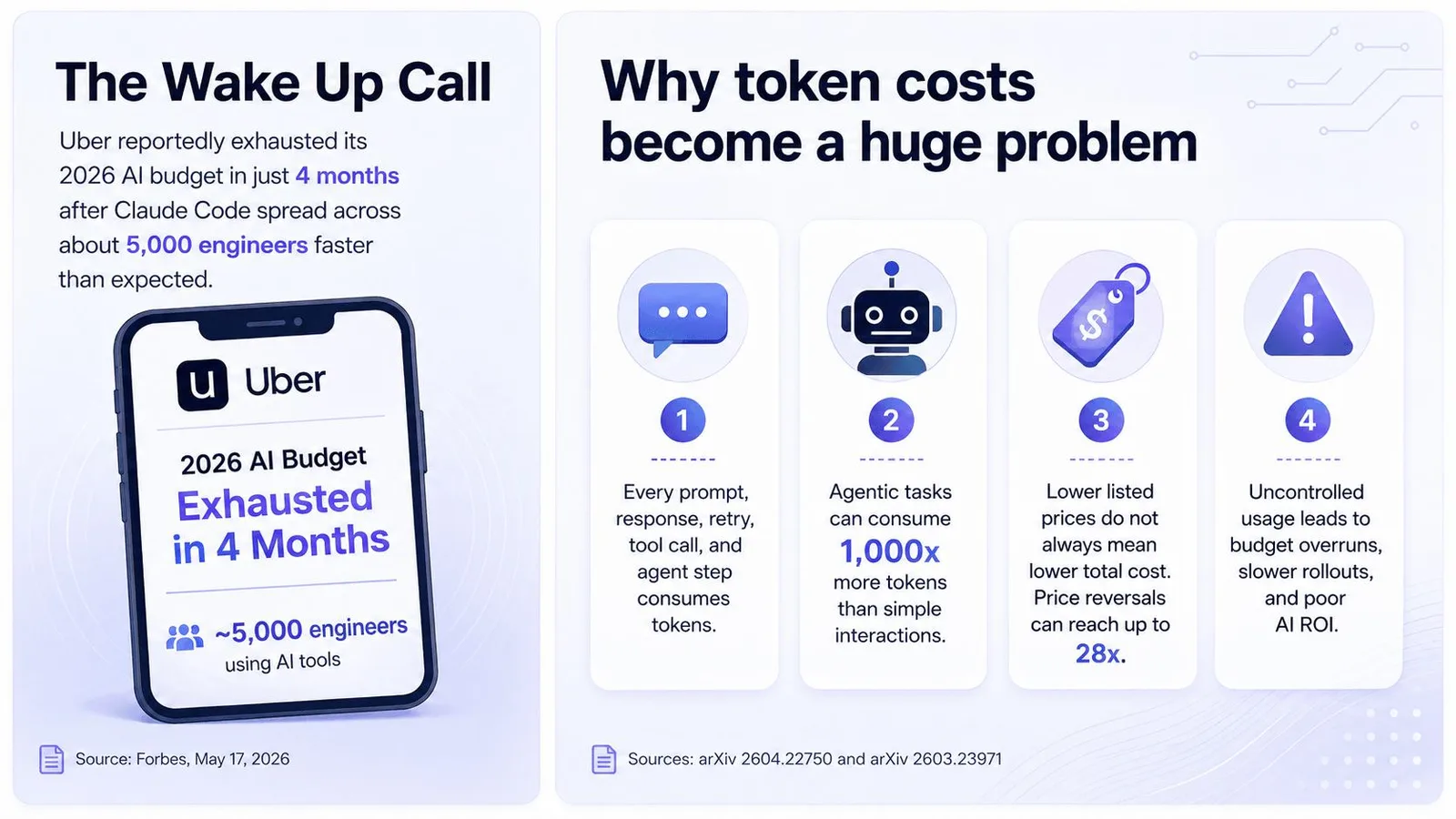
The cost problem becomes more serious when enterprises start using AI agents.
A normal chatbot may answer one question.
An AI agent may:
- Understand the task
- Create a plan
- Search internal systems
- Read documents
- Call tools
- Write output
- Check the result
- Fix mistakes
- Retry failed steps
- Escalate if needed
Each of those steps can consume tokens.
Recent research on agentic coding found that agentic tasks can consume about 1,000 times more tokens than code chat or code reasoning tasks. The same study also found that repeated runs of the same task can vary by up to 30 times in total token usage. [2]
That is a huge issue for enterprises.
It means AI cost is not always predictable, even when the task looks predictable.
Two employees may ask for similar outcomes, but the agent may spend very different amounts of tokens getting there.
That makes cost planning harder.
Cheaper Models Are Not Always Cheaper in Practice
Many enterprises assume they can solve the problem by choosing models with lower listed prices.
That helps, but it is not enough.
A model with cheaper input and output pricing can still become expensive if it uses more tokens, takes more steps, or requires more retries.
Research on reasoning models found that in some cases, models with lower listed prices ended up having higher actual total costs. The study called this the price reversal problem. [3]
This matters because enterprises cannot look only at the price per token.
They need to look at:
- Total tokens consumed
- Number of reasoning steps
- Number of tool calls
- Number of retries
- Output quality
- Latency
- Failure rate
- Need for human review
- Cost per completed task
The real question is not:
Which model looks cheapest?
The better question is:
Which model completes this task reliably at the lowest total cost?
LLM Cost Optimization Strategies for Enterprises
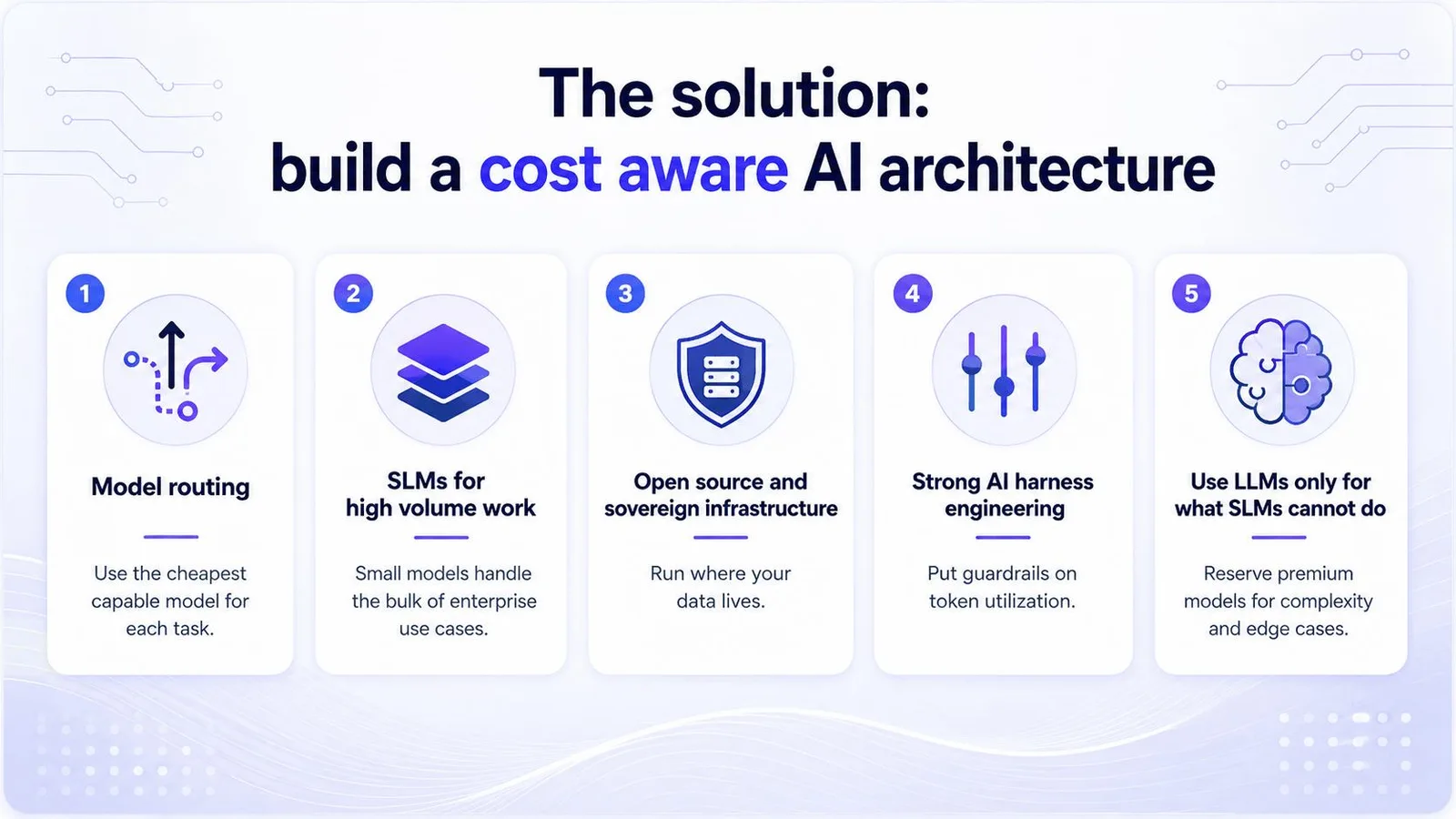
Enterprises should not respond to this problem by simply telling employees to stop using AI.
That would be the wrong lesson.
The real solution is to build AI systems that are cost aware from the beginning.
That means designing the AI architecture around:
- Cost
- Quality
- Security
- Latency
- Data control
- Workflow complexity
- Business value
The goal is simple.
Use the right model for the right task at the right cost.
1. Use Model Routing for LLMs to Pick the Cheapest Capable Model
Not every task needs the most powerful model.
Many enterprise tasks are simple, repetitive, and structured.
For example:
- Classifying support tickets
- Extracting invoice fields
- Routing customer queries
- Summarizing standard documents
- Checking policy rules
- Tagging CRM records
- Drafting routine responses
- Matching purchase orders
- Updating internal records
These tasks do not always need a frontier LLM.
A model routing layer can decide which model should handle each task.
A good model router looks at:
- Task type
- Complexity
- Risk level
- Data sensitivity
- Required accuracy
- Required speed
- Expected token usage
- Business value of the request
Then it routes the task to the cheapest model that can do the job well.
For example:
- Simple classification can go to a small model
- Routine extraction can go to a trained SLM
- Internal document search can use an open source model
- Complex reasoning can go to a larger LLM
- High risk exceptions can go to a frontier model with human review
This one change can make enterprise AI much more sustainable.
2. Use Small Language Models for Enterprise Volume
Small Language Models will become very important for enterprise AI.
The reason is simple.
Most enterprise work is not random.
It is repetitive and domain specific.
For example:
- Banks process similar forms again and again
- Insurers handle similar claims again and again
- Retailers answer similar order questions again and again
- HR teams respond to similar policy questions again and again
- Finance teams review similar invoices again and again
- Support teams classify similar tickets again and again
These are perfect use cases for SLMs.
An SLM can be trained for a specific business function, department, or workflow.
That gives enterprises several advantages:
- Lower cost
- Faster response time
- More control
- Better domain fit
- Easier governance
- More predictable behavior
- Reduced dependency on premium LLMs
The future enterprise AI stack will not use one large model for everything.
It will use many purpose built models for specific tasks.
3. Use Open Source Models With On Prem or Sovereign Infrastructure
Open source models can also help enterprises reduce cost and improve control.
This is especially important for industries such as:
- Banking
- Insurance
- Healthcare
- Government
- Telecom
- Manufacturing
- Defense
- Legal services
These industries often have strict requirements around data security, privacy, and residency.
Open source models can be deployed in:
- Private cloud
- On prem infrastructure
- Sovereign cloud
- Region specific environments
- Enterprise controlled infrastructure
This helps enterprises in three ways.
First, they get better control over sensitive data.
Second, they reduce complete dependency on external model providers.
Third, they can optimize infrastructure for high volume tasks.
This does not mean every enterprise should move everything on prem.
It means enterprises should have options.
Some workloads can run on managed LLM APIs.
Some can run on private infrastructure.
Some can run on open source models.
Some can run on SLMs.
Some can escalate to large LLMs only when needed.
That flexibility is what makes AI scalable.
4. Build AI Cost Governance Into the AI Harness
A strong AI harness is one of the most important parts of enterprise AI architecture.
Think of the AI harness as the control system around the model.
It manages:
- Prompts
- Context
- Retrieval
- Tools
- Memory
- Model routing
- Cost limits
- Guardrails
- Monitoring
- Evaluation
- Escalation
- Security
Without this layer, AI usage can become messy very quickly.
A strong AI harness should control token usage by using:
- Token budgets per workflow
- Token budgets per team
- Prompt compression
- Context filtering
- Context deduplication
- Response length limits
- Caching for repeated queries
- Smart retrieval instead of full document loading
- Retry limits
- Agent loop limits
- Cost alerts
- Usage dashboards
- Human handoff rules
This matters because a lot of token waste comes from poor engineering.
For example:
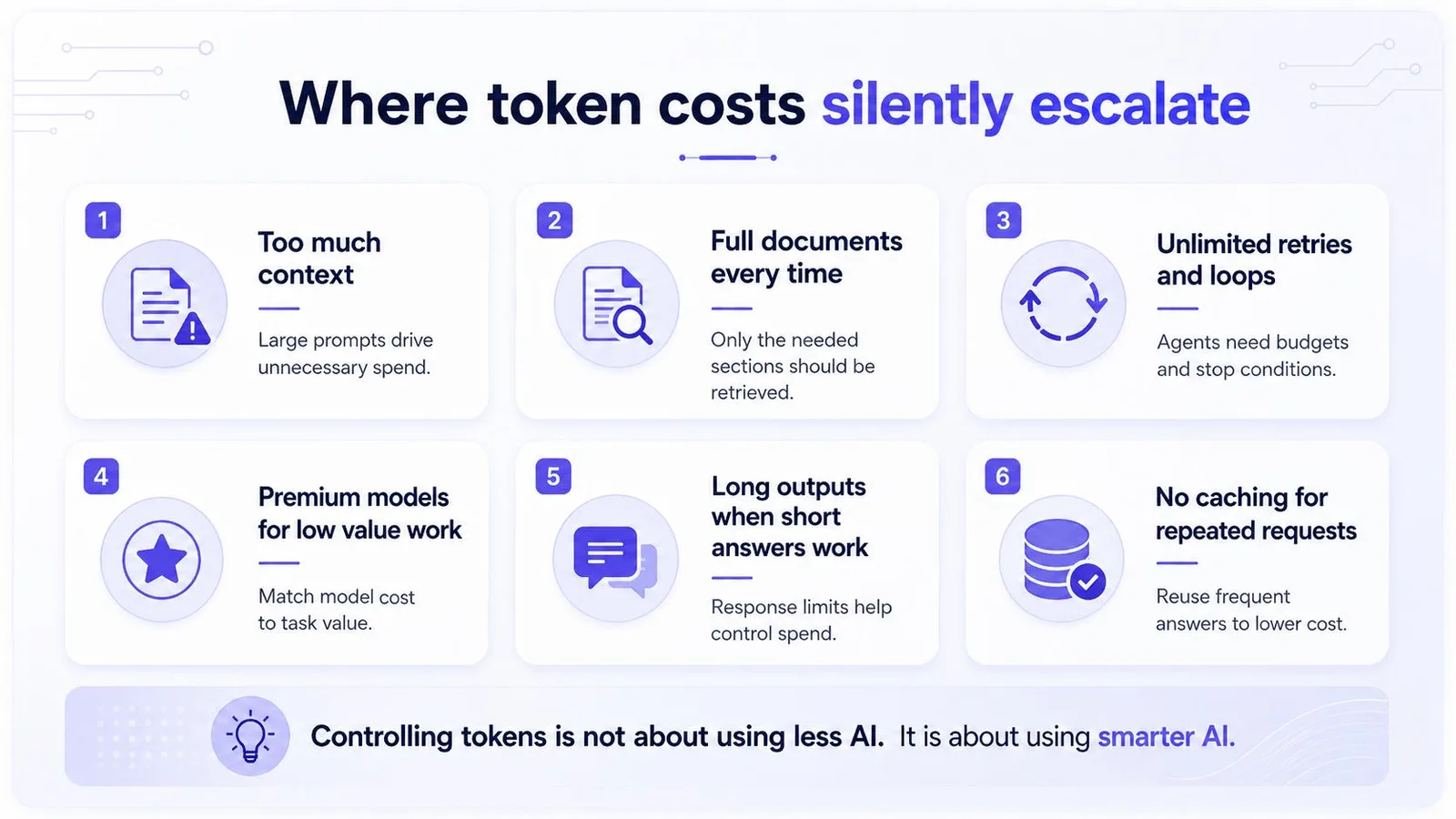
- Sending too much context to the model
- Asking the model to read full documents when only one section is needed
- Letting agents retry without limits
- Using long prompts for simple tasks
- Using premium models for low value work
- Generating long responses when short answers are enough
- Running the same request again and again without caching
Good AI harness engineering prevents this waste.
It gives enterprises control before costs become a problem.
5. Create Specific SLMs for the Bulk of Enterprise Use Cases
The best long term strategy is to create specific SLMs for the work enterprises do most often.
For example:
- A customer support SLM for common service questions
- A finance SLM for invoices and purchase orders
- A legal SLM for contract clause classification
- An HR SLM for policy questions
- A healthcare SLM for patient intake
- A retail SLM for order tracking and returns
- A banking SLM for KYC document review
- A manufacturing SLM for maintenance logs
- A sales SLM for lead qualification
These models can handle the bulk of enterprise volume.
Then larger LLMs can be used only for:
- Complex reasoning
- Unusual edge cases
- New scenarios
- High judgment tasks
- Strategic analysis
- Tasks outside the SLM training scope
This creates a much better cost structure.
SLMs handle volume.
LLMs handle complexity.
The AI harness decides when to use each one.
Why LLMs Should Not Be the Default for Every Task
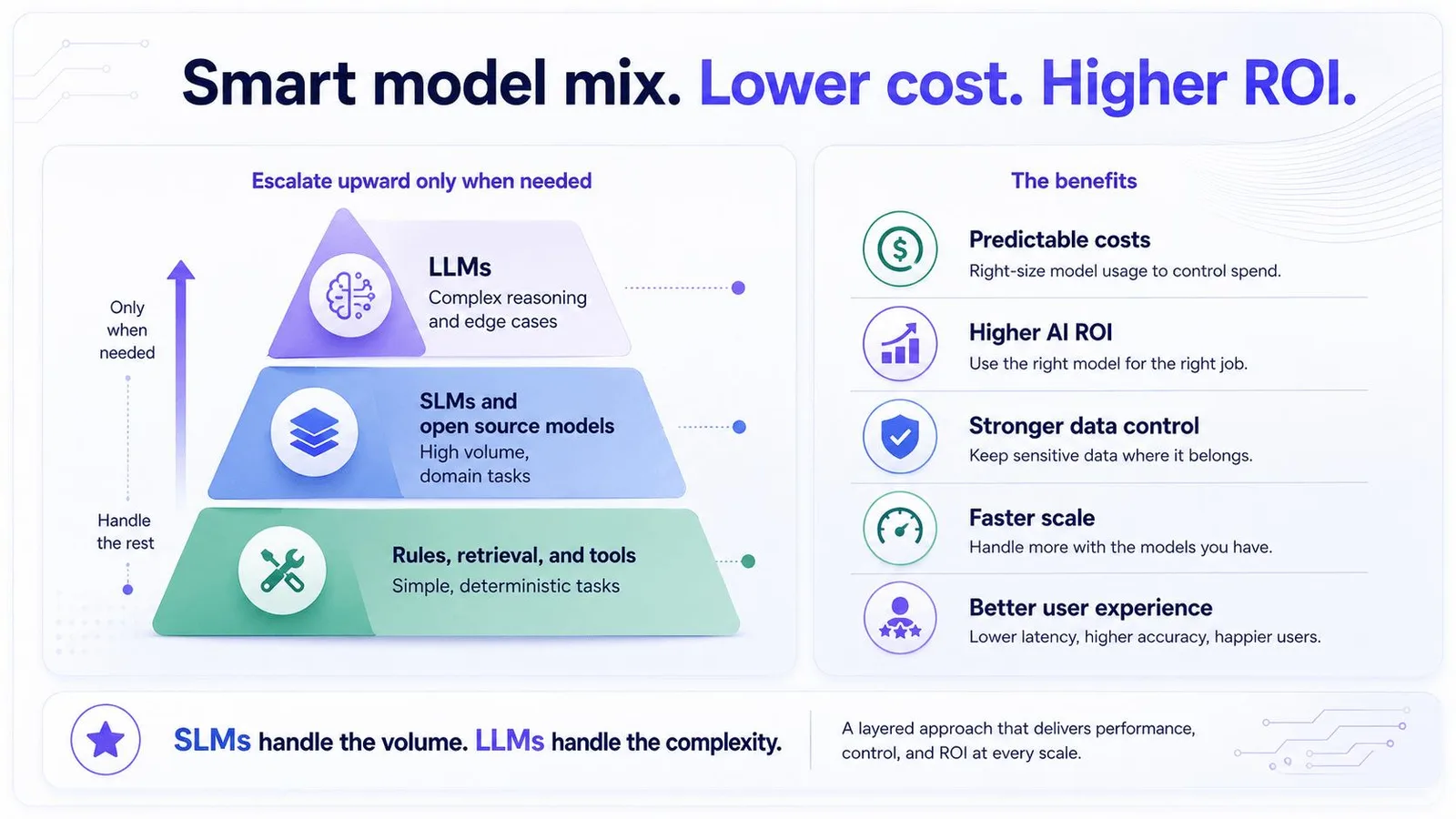
Large LLMs are powerful.
But using them for everything is like using a senior expert for every small admin task.
It works, but it is expensive.
Enterprises need to stop asking:
Which LLM should we use for this?
They should start asking:
What is the lowest cost way to complete this task safely and accurately?
Sometimes the answer is a large LLM.
But sometimes the answer is:
- A smaller model
- An SLM
- An open source model
- A rule based workflow
- A retrieval system
- A template
- A human review step
- No generative AI at all
That is how enterprises will move from AI experimentation to AI operations.
The CFO Will Care About AI Architecture
AI architecture is no longer just a technology decision.
It is becoming a finance decision too.
CFOs will want to know:
- Which teams are using the most tokens?
- Which workflows are creating the most cost?
- Which models are overused?
- Which prompts are inefficient?
- Which agents are looping too much?
- Which use cases are producing measurable ROI?
- Which tasks should move to SLMs?
- Which tasks justify premium LLM usage?
This is why AI FinOps will become a serious discipline.
Enterprises already manage cloud costs carefully.
They will need to manage AI costs with the same discipline.
What a Cost-Aware Enterprise AI Architecture Looks Like
A scalable enterprise AI stack should include:
- Model routing
- SLMs for high volume tasks
- Open source models where useful
- On prem or sovereign infrastructure where required
- AI harness engineering
- Token budgets
- Prompt optimization
- Context management
- Caching
- Usage dashboards
- Cost alerts
- Quality monitoring
- Human escalation
- Governance by team and workflow
This is not just about saving money.
It is about making AI reliable enough to scale.
Conclusion: LLM Cost Optimization Will Decide Enterprise AI ROI
AI adoption will keep growing.
But enterprises that do not control token costs will face a painful reality.
They may have strong AI demand, but weak AI economics.
That can lead to:
- Budget overruns
- Slower rollouts
- Reduced trust from leadership
- Stalled pilots
- Poor ROI visibility
- Restrictions on employee usage
- Missed automation opportunities
The winners will take a different path.
They will build AI systems that are cost aware from day one.
They will:
- Route tasks to the cheapest capable model
- Use SLMs for repetitive work
- Use open source models where they make sense
- Deploy on prem or sovereign infrastructure when needed
- Build strong AI harnesses
- Control token usage at every layer
- Use large LLMs only when the task truly needs them
The first phase of enterprise AI was about proving what AI can do.
The next phase will be about proving that AI can scale profitably.
And that will depend on one thing more than most leaders realize.
Controlling LLM token costs.
LLM Cost Optimization FAQ for Enterprise AI Teams
What is LLM cost optimization?
LLM cost optimization is the practice of reducing the total cost of enterprise AI workloads by controlling LLM token costs, routing requests to the cheapest capable model, limiting context, caching repeated work, and measuring cost per completed AI task.
Why do AI token costs increase so quickly in enterprises?
AI token costs rise quickly when employees and agents process long prompts, large documents, retrieved context, tool calls, retries, and multi-step workflows without token budgets or AI cost governance.
How can model routing reduce LLM costs?
Model routing reduces LLM costs by sending each task to the lowest-cost model or workflow that can complete it safely, such as rules, retrieval, small language models, open-source models, or premium LLMs only when needed.
What is LLM FinOps?
LLM FinOps applies financial operations discipline to enterprise AI by tracking token usage, model spend, cost per workflow, retry behavior, team-level budgets, and ROI across AI applications.
How do SLMs reduce enterprise AI costs?
Small language models reduce enterprise AI costs by handling high-volume, repeatable tasks with lower inference cost while larger LLMs are reserved for complex reasoning, unusual cases, and strategic work.
Are open-source models cheaper than managed LLM APIs?
Open-source models can be cheaper for predictable, high-volume enterprise workloads, especially on private or on-prem infrastructure, but total cost depends on infrastructure, operations, tuning, evaluation, and governance.
How should enterprises set token budgets for AI agents?
Enterprises should set token budgets by workflow, team, model, and task type, with limits for context size, tool calls, retries, output length, escalation rules, alerts, and human handoff.
References
- [1] Forbes, “Uber Burns Its 2026 AI Budget in Four Months on Claude Code,” May 17, 2026.
- [2] arXiv 2604.22750, research on the economics of AI coding tools and token usage in agentic tasks.
- [3] arXiv 2603.23971, research on reasoning model costs and price reversal in total task cost.