Rising AI subscription costs
Legal AI tools can look manageable in a pilot, then become harder to justify as usage expands across attorneys, reviewers, practice groups, and delivery teams.

Legal services and ALSPs
Build legal AI intelligence your firm can own.
Legal firms and Alternative Legal Service Providers (ALSPs) are adopting AI quickly, but access to the same broad tools as everyone else will not create a lasting advantage. The next edge comes from turning approved playbooks, review history, clause decisions, redlines, workflows, and delivery standards into private AI intelligence.
Private AI for legal firms means keeping sensitive data, prompts, retrieval, outputs, and model operations inside controlled infrastructure.
ALSPs and legal managed services providers use private AI to improve high-volume review, classification, intake, and delivery workflows.
Task-specific SLMs fit legal operations because many tasks are repeatable, sensitive, structured, and tied to firm-specific rules.
Problems
Most legal teams are already experimenting with AI or using AI-enabled tools. As usage grows, the hard questions move from "Can we use AI?" to "Can we control it, afford it, govern it, and make it ours?"
Legal AI tools can look manageable in a pilot, then become harder to justify as usage expands across attorneys, reviewers, practice groups, and delivery teams.
Long documents, large context windows, comparisons, repeated prompts, and multi-step reviews can make AI usage difficult to forecast and control.
Privileged documents, contracts, breach data, employee records, financial information, and matter files need stronger handling than casual experimentation allows.
Many tools can retrieve or summarize knowledge, but they do not always turn review history, redlines, and clause decisions into a reusable private model asset.
If every firm uses the same broad AI layer, differentiation fades. The durable advantage comes from systems shaped around your own standards.
The SLM advantage
Broad AI models are useful for general research, drafting, summarization, and productivity support. But many legal operations workflows are narrower: repetitive, sensitive, structured, and dependent on firm-specific rules.
That is where private, task-specific Small Language Models create a stronger operating model.

SLMs can be trained or adapted for clause extraction, PII review, document classification, risk scoring, and issue tagging.
Approved playbooks, clause libraries, review decisions, redlines, matter workflows, and structured outputs can guide the model.
Not every legal task needs a large external model. Smaller private models can handle repeatable work more predictably.
Private SLMs can run on-prem, in private cloud, in secure VPCs, or in hybrid architectures approved by the firm.
Your expertise becomes a private AI layer that improves around your workflows and is harder for competitors to copy.
Use cases
Private SLMs work best where the task is document-heavy, high-volume, sensitive, and dependent on firm or client-specific standards. The goal is not to automate judgment away, but to make repeatable review work more consistent, governed, and measurable.

Legal teams review large volumes of NDAs, MSAs, DPAs, SaaS agreements, vendor contracts, employment agreements, and service agreements. A private SLM can extract key clauses and score them against approved playbooks, fallback positions, risk thresholds, and escalation rules.
What it can support
Why it matters: Contract review is repetitive, but it still needs firm-specific judgment. A private SLM can improve consistency while reducing reliance on broad external models for every review task.
Privacy, breach response, and managed review teams often need to identify sensitive information across large document sets, including names, addresses, emails, phone numbers, Social Security numbers, financial data, medical references, and employee information.
What it can support
Why it matters: Breach review is sensitive, time-bound, and data-heavy. Private SLMs can support faster review while keeping confidential information inside controlled environments.
Litigation and managed review teams classify documents based on matter-specific protocols, relevance criteria, issue tags, custodians, privilege indicators, and historical coding decisions.
What it can support
Why it matters: Generic tools can summarize documents, but eDiscovery requires matter-specific consistency. Private SLMs can be trained around review protocols and prior coding decisions.
Many firms and ALSPs support clients with large contract repositories that need to become structured legal and business data.
What it can support
Why it matters: Contract abstraction is high-volume and structured. A private SLM can extract obligations consistently based on the client's schema and review standards.
Legal teams often need to classify documents by type, matter, risk, workflow stage, sensitivity, or required action.
What it can support
Why it matters: Classification is a strong SLM use case because it is repetitive, measurable, and directly tied to operational efficiency.
Law firms and ALSPs receive requests across emails, portals, forms, ticketing systems, and client channels. Those requests need to be routed quickly and accurately.
What it can support
Why it matters: Intake is often where legal operations efficiency begins. Private SLMs can route work faster while learning from approved historical routing patterns.
How we help
Sovereign SLM Labs helps legal firms and ALSPs move from AI experimentation to controlled, firm-owned AI capability. Our work covers strategy, architecture, model selection, training, deployment, governance, and integration.

We identify where private AI can create the highest value across legal operations, client delivery, knowledge management, and practice workflows.
We select, train, and adapt Small Language Models for specific legal workflows, accuracy needs, infrastructure needs, and cost profiles.
We help convert approved internal knowledge into private AI intelligence aligned with workflow patterns, review standards, and client-specific rules.
Model routing helps legal firms reduce AI cost by sending simpler workflows to smaller private models and reserving larger models for complex reasoning tasks.
We help legal teams deploy AI in controlled environments for confidential matters, privileged documents, breach data, and client-restricted information.
Private RAG allows legal teams to search approved internal knowledge without exposing sensitive legal documents to uncontrolled external AI systems.
We integrate private AI into the systems legal teams already use so it becomes part of real work instead of another isolated tool.
Legal AI must be controlled, auditable, and reliable. We design governance layers around access, review, validation, logging, and monitoring.
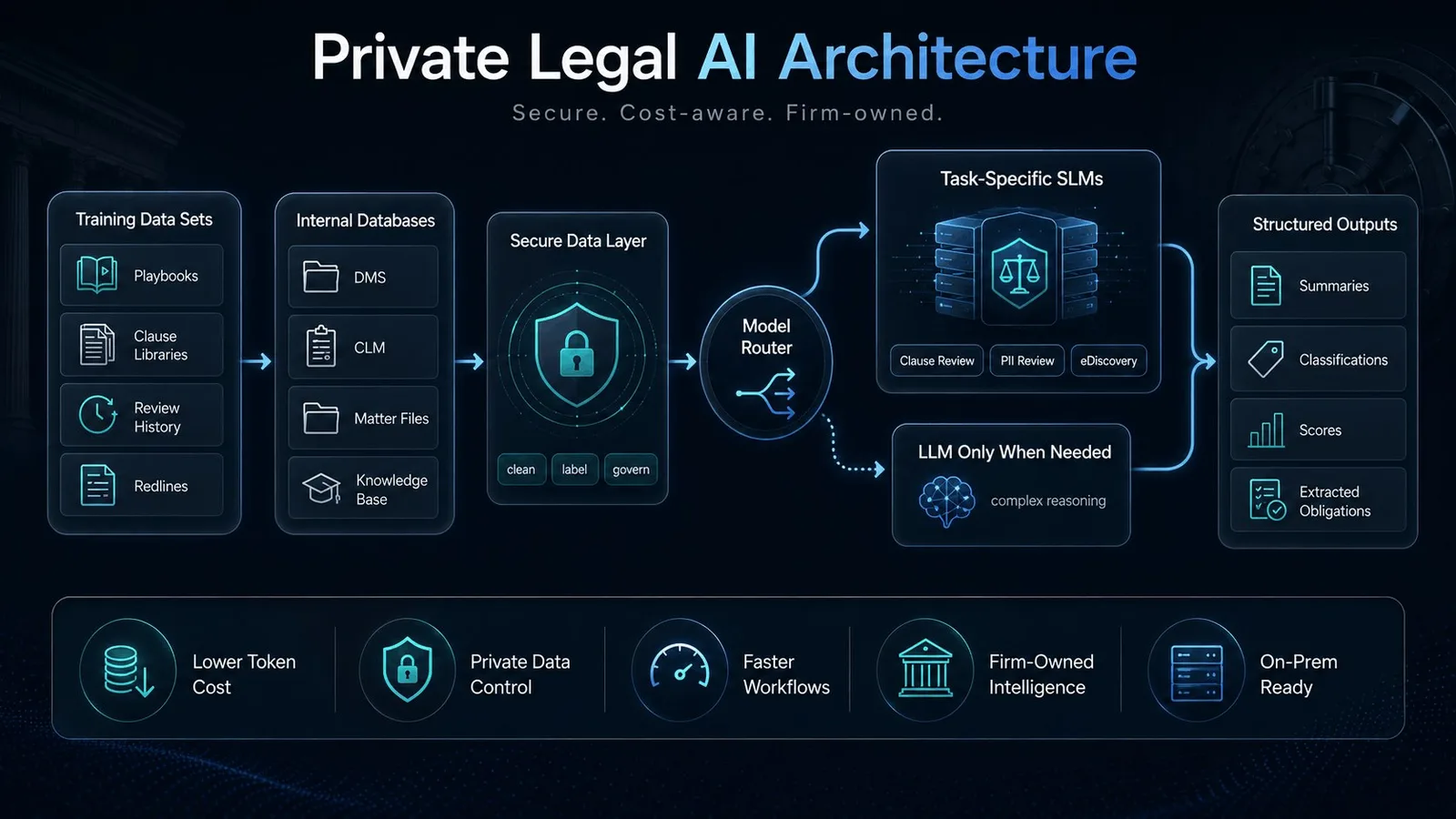
Architecture
A strong legal AI architecture does not force every task through one model. It routes work based on sensitivity, complexity, cost, and accuracy needs.
Simple classification can go to a small private model.
Clause extraction can go to a task-specific SLM.
Internal knowledge Q&A can use private RAG over approved sources.
Complex reasoning can use larger models with controls, escalation, and monitoring.
Related reading
These guides expand the architecture patterns behind private legal AI, local deployment, model routing, and cost-aware SLM strategy.

Workshop
Explore how Sovereign SLM Labs can help your team build private, task-specific AI around your own legal workflows.
Map one high-value legal workflow suitable for private SLMs.
Identify where model training, routing, or local AI can reduce dependency.
Build a practical roadmap for private legal AI implementation.
FAQ
Private AI for legal firms means deploying AI systems inside controlled environments where confidential client data, prompts, model outputs, and retrieval pipelines remain governed by the firm's approved infrastructure.
Alternative Legal Service Providers (ALSPs), also called legal managed services providers, deliver legal operations services such as contract review, eDiscovery support, legal intake, document review, compliance operations, and managed legal workflows.
ALSPs use private AI to improve high-volume legal workflows such as contract review, eDiscovery, breach review, document classification, obligation extraction, and legal intake routing while keeping sensitive data under stronger controls.
A private SLM for legal workflows is a task-specific Small Language Model trained or adapted for a defined legal process such as clause extraction, risk scoring, PII detection, issue tagging, or matter routing.
A Small Language Model is narrower, lighter, and easier to optimize for a specific workflow. A broad LLM is more general-purpose and may be useful for complex reasoning, but it can be more expensive for repeatable legal operations tasks.
Yes. A private SLM can be trained or adapted using approved playbooks, clause libraries, prior review decisions, redlines, risk labels, coding decisions, structured outputs, and workflow decisions.
Private SLMs are well suited for contract clause extraction, PII detection, breach review, eDiscovery issue tagging, obligation extraction, legal document classification, and legal intake routing.
Private AI can reduce token costs by routing simpler and repeatable tasks to smaller private models, reserving larger models for complex reasoning, and avoiding unnecessary long-context processing for routine legal workflows.
Yes. Private AI can run on-prem, in private cloud, in a controlled VPC, in dedicated GPU environments, in air-gapped environments, or through a hybrid AI architecture.
Model routing for legal AI sends each task to the right model based on sensitivity, complexity, cost, latency, and accuracy needs. It keeps routine work on smaller private models and reserves larger models for harder tasks.
Private RAG lets legal teams search approved internal knowledge such as matter files, playbooks, templates, contract repositories, and knowledge bases without exposing sensitive documents to uncontrolled external AI systems.
Yes. Private AI can integrate with document management systems, contract lifecycle management platforms, matter management systems, eDiscovery tools, ticketing systems, internal APIs, and identity systems.
Private AI helps protect confidential client data by keeping sensitive documents, prompts, retrieval, outputs, logs, and access controls inside approved infrastructure with governance, auditability, and human review.
It does not have to replace existing tools. Private AI can complement them by handling sensitive, repeatable, firm-specific workflows and by routing tasks across private models, private RAG, and approved external tools.
Legal firms can build firm-owned AI intelligence by converting approved playbooks, review history, redlines, clause decisions, workflows, and delivery standards into private models, retrieval systems, governance rules, and feedback loops.