Citizens need guidance
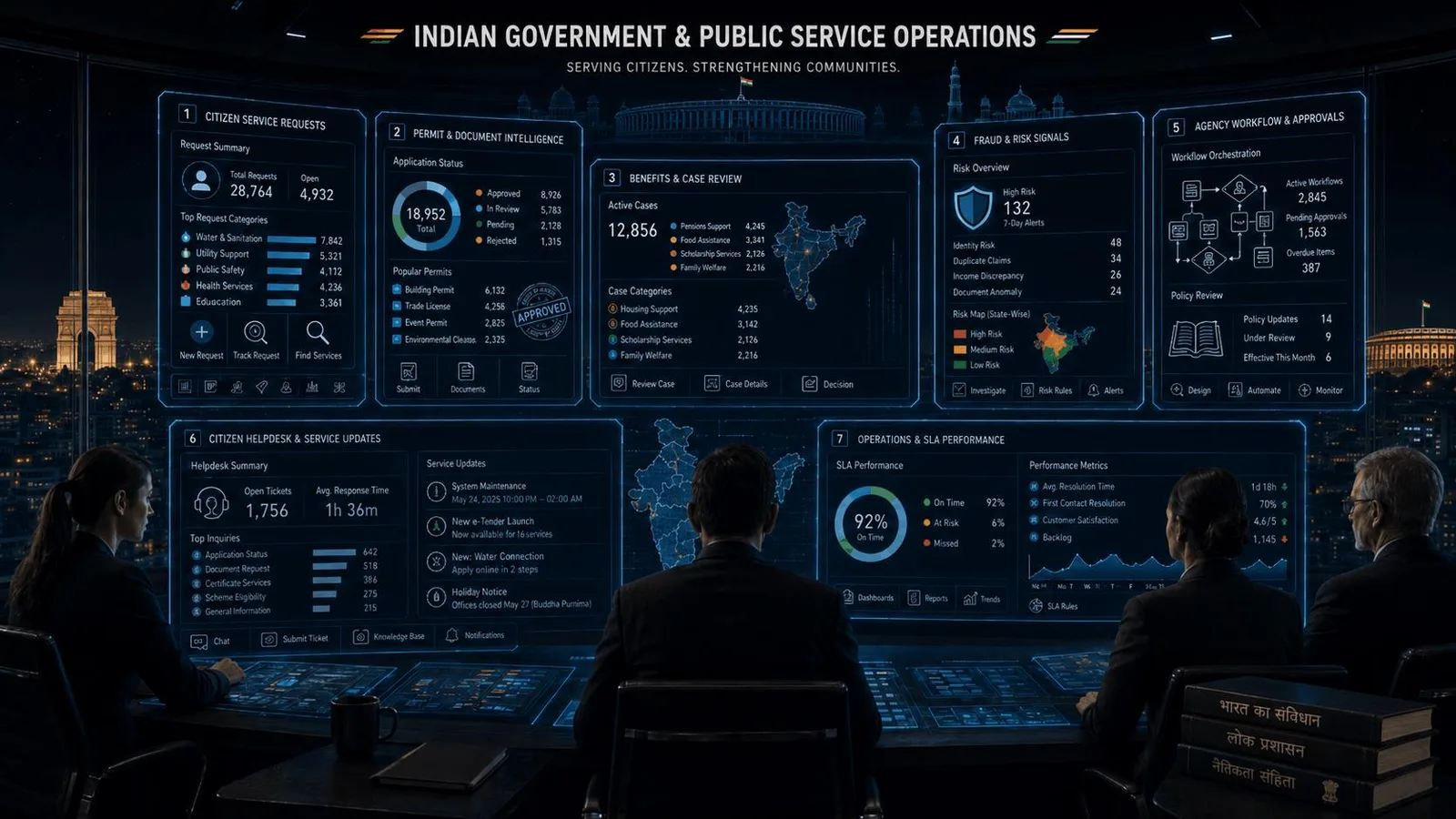
A citizen may know the problem, but not the exact scheme, department, jurisdiction, portal, or document requirement.
Government and public sector
Build AI for public services without giving up control.
Sovereign SLM Labs helps ministries, state departments, public-sector enterprises, urban local bodies, and agencies build private AI agents and task-specific Small Language Models around their own policies, records, service rules, and citizen workflows.

Private AI for government keeps citizen information, departmental knowledge, prompts, outputs, and agent actions inside approved infrastructure and governance boundaries.
Government AI agents can support citizen services, grievance redressal, schemes, document processing, procurement files, policy search, and field operations.
Task-specific government SLMs fit defined workflows where answers must be grounded in approved rules, circulars, case records, and officer review paths.
The challenge
Citizens may start with a need rather than a department name. Officers may need to check forms, certificates, case notes, scheme rules, circulars, file history, and service timelines before a decision can move forward. A useful government AI system must help with that work without becoming an unaccountable decision-maker.
A citizen may know the problem, but not the exact scheme, department, jurisdiction, portal, or document requirement.
Applications often require identity records, certificates, declarations, inspection reports, and supporting evidence.
Answers may depend on Acts, rules, government orders, circulars, scheme guidelines, office memoranda, and previous files.
A case may move across citizen portals, file systems, document repositories, call centers, spreadsheets, and departmental tools.
Officials need source traceability, rule references, audit logs, confidence thresholds, and clear escalation paths.
The SLM advantage
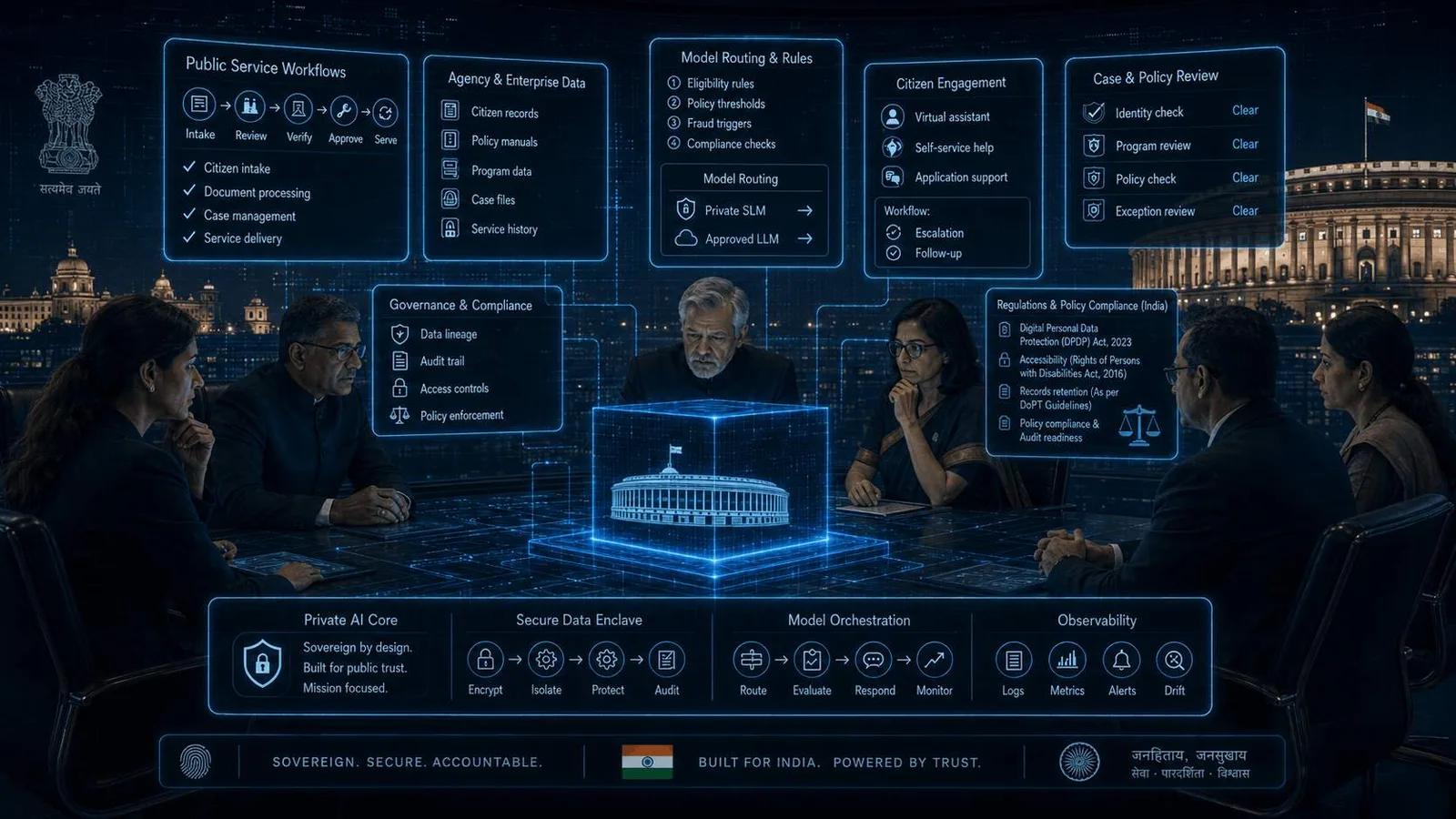
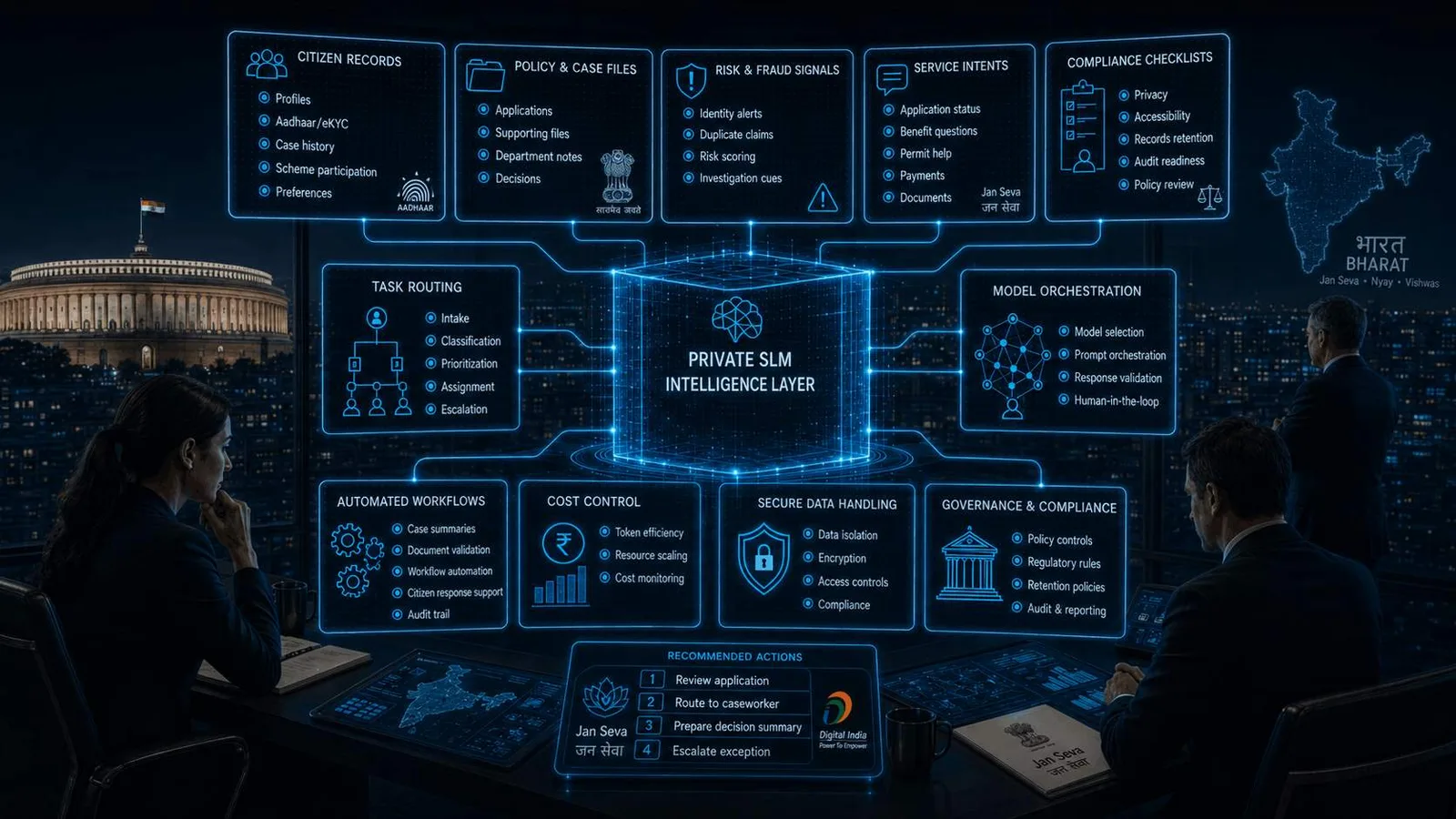
A dependable public-sector AI system combines the right technology for each task: rules engines for formal eligibility, document AI for forms, private RAG for approved knowledge, analytical models for risk signals, task-specific SLMs for extraction and summarization, and officers for accountable decisions.
Defined tasks: grievance classification, application review, policy search, case summarization, scheme discovery, deficiency notices, and response preparation.
Approved knowledge: Acts, rules, scheme documents, circulars, service standards, office memoranda, departmental manuals, FAQs, and historical case decisions.
Deployment control: India-hosted private cloud, government-controlled VPCs, State Data Centres, on-premises infrastructure, air-gapped environments, or hybrid architectures.
Make in India
A sovereign AI system should give the institution control over its data, hosting, model customization, knowledge sources, and operational continuity. Our approach supports local capability, Indian-language service delivery, India-hosted infrastructure, and reduced dependence on foreign AI APIs.
India-hosted model infrastructure and customer-managed encryption
Indian-language voice, text, translation, and regional terminology support
Institution-owned model customization, private RAG, and knowledge governance
Integration with approved digital public infrastructure and departmental systems
Use cases
The strongest starting points are bounded workflows where the agent can gather facts, retrieve approved sources, summarize the file, and route exceptions to an authorized official.
01
Understands citizen needs, explains services, guides forms, checks status, supports voice or text, and transfers complex cases to helpdesks.
02
Classifies grievances, identifies the right department or jurisdiction, summarizes the issue, detects duplicates, tracks timelines, and escalates overdue cases.
03
Classifies applications, extracts fields, checks completeness, compares supporting records, prepares deficiency notices, and routes files for review.
04
Starts with the citizen's situation, finds relevant schemes, explains eligibility, lists required documents, and guides the application process.
05
Summarizes applicant history, retrieves relevant scheme clauses, identifies inconsistencies, builds a case chronology, and prepares internal notes.
06
Searches circulars, manuals, orders, previous files, service rules, and approved FAQs with source-backed answers and effective dates.
07
Routes property tax, sanitation, water, trade license, certificate, ward, inspection, and status-update requests through one conversational entry point.
08
Extracts tender requirements, checks bid completeness, compares technical responses, drafts clarifications, and prepares audit-ready evaluation packs.
09
Retrieves checklists, shows previous records, captures voice notes, drafts visit reports, flags missing details, and creates follow-up tasks.
10
Summarizes risk indicators, connects related cases, compares supporting records, builds timelines, and prepares evidence packs for investigators.
11
Classifies submissions, identifies recurring themes, compares policy versions, extracts evidence, and links every insight to its source.
12
Classifies requests, identifies the responsible office, locates related records, builds file chronologies, monitors deadlines, and drafts review-ready responses.
Operational layer
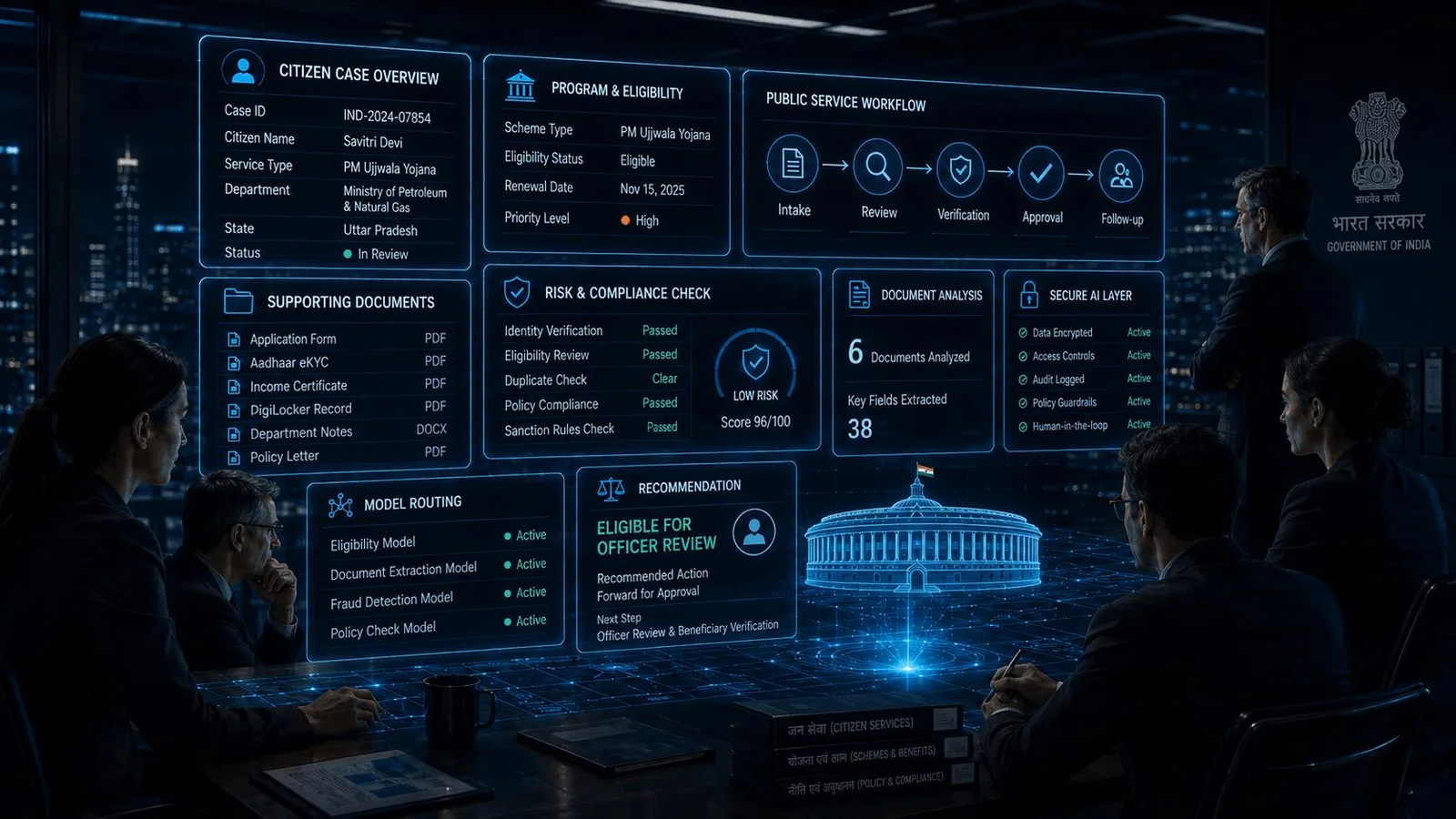
The agent should organize information, retrieve source material, check completeness, produce structured summaries, and recommend next steps. Material approvals, benefit decisions, penalties, enforcement actions, and disclosure decisions should remain with authorized officials.
Officer-in-the-loop: clear escalation rules for approvals, exceptions, appeals, investigations, and sensitive citizen outcomes.
Evidence-first outputs: file summaries, document gaps, cited policy sources, eligibility checks, risk signals, and action history.
Controlled actions: request information, create tasks, route cases, update status, draft responses, and log every workflow step.
How we help
We define the workflow, data boundaries, language needs, officer approvals, validation criteria, and public-value metrics before choosing the model stack.
Use-case prioritization, data-sensitivity review, India-hosting requirements, multilingual AI planning, pilot selection, governance design, and outcome measurement.
Agents that read forms, retrieve approved knowledge, interact with authorized systems, request missing information, route cases, and maintain audit trails.
Models adapted using approved scheme documents, service FAQs, grievance categories, application records, process documents, and structured officer decisions.
Citizen-facing agents can support Hindi and regional-language interactions across voice, text, assisted-service channels, and mobile applications.
Compact models handle routine classification and extraction; larger models are reserved for controlled complex reasoning or long-document analysis.
Deployment across State Data Centres, government-controlled data centers, India-hosted private cloud, controlled VPCs, dedicated GPU environments, or air-gapped networks.
Architecture
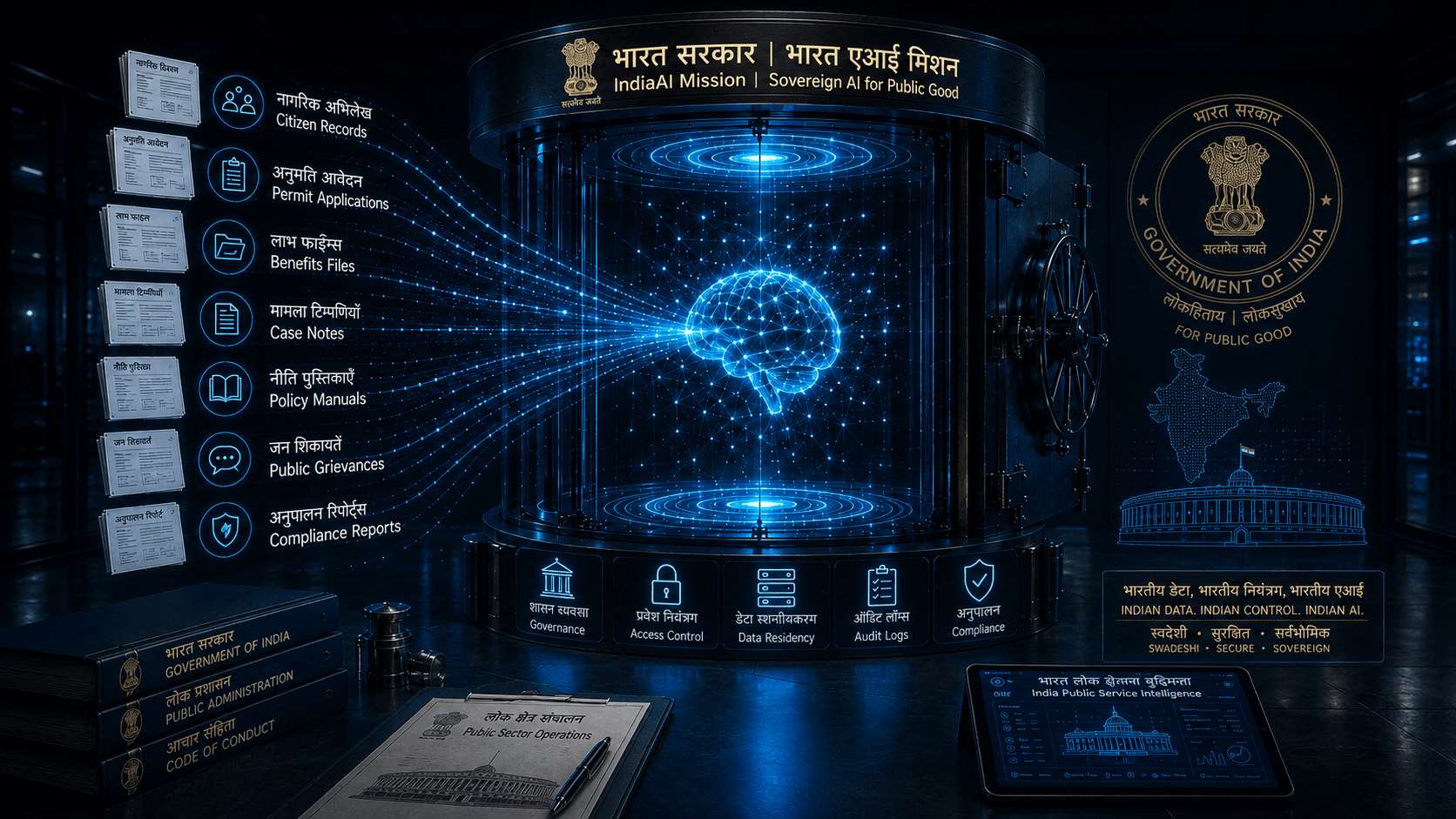
A public-sector AI architecture should separate data access, model routing, retrieval, deterministic rules, workflow actions, officer review, source traceability, and monitoring. That separation matters when systems touch citizen records, benefits, licenses, procurement, enforcement, grievances, or personal data.
Approved government data includes citizen requests, applications, case history, policies, schemes, service standards, departmental records, and correspondence.
Secure data layer enforces access controls, encryption, data minimization, lineage, retention policies, India data residency, and audit requirements.
Task-specific government SLMs handle grievance classification, document extraction, case summarization, scheme discovery, and draft response preparation.
Agentic workflow layer creates cases, routes requests, assigns tasks, asks for information, communicates status, records actions, and escalates human-review decisions.
Governance note
Agents should not independently approve benefits, reject applications, trigger penalties, disclose sensitive information, override formal rules, or make enforcement decisions. The system should prepare the file, expose evidence, and involve the right official at the right point.
Role-based access, least-privilege permissions, and data minimization
Source traceability, version-controlled policies, and deterministic rule checks
Human approval for material decisions, exceptions, appeals, and enforcement
Audit logs, model-version tracking, bias testing, incident reporting, and controlled change management
Related reading
These pages expand the architecture patterns behind local deployment, model routing, private RAG, and cost-aware SLM strategy.
Workshop
Government AI adoption does not have to begin with a large transformation program. Start with one workflow where citizens, officers, or agencies already lose time: grievance classification, scheme discovery, application completeness, departmental policy search, municipal service requests, field inspection reporting, or procurement-document review.
Select the right first workflow for private SLMs and agentic AI.
Assess data, language, integration, governance, and officer-review boundaries.
Build and validate a practical roadmap for wider public-sector adoption.
FAQ
Agentic AI for government refers to systems that can understand a service request, retrieve authorized information, complete permitted workflow steps, and escalate decisions that require an official.
Government AI agents support citizen services, grievances, document processing, schemes, case management, policy search, knowledge retrieval, and internal administration.
A chatbot mainly answers questions. An AI agent can also read documents, create cases, retrieve records, route requests, ask for missing information, and monitor workflow progress.
A government SLM is a smaller language model designed for a focused public-sector task such as application extraction, grievance classification, case summarization, or policy retrieval.
Yes. Private agents can combine task-specific SLMs with approved speech, translation, and text capabilities to support Hindi and regional-language service interactions.
An agent can prepare the case, check completeness, retrieve policy context, and recommend next steps. Approval should remain governed by formal rules and authorized officers.
Yes. Government AI can be deployed in India-hosted private cloud, government-controlled VPCs, State Data Centres, on-premises environments, or air-gapped networks depending on requirements.
Sovereign AI gives the institution greater control over its data, models, infrastructure, knowledge assets, intellectual property, and operational continuity.
Use approved retrieval sources, source citations, version-controlled policies, deterministic rules, structured outputs, confidence thresholds, restricted actions, audit logs, and human review.