Operational data is fragmented
Production issues may require context from MES, ERP, SCADA, historians, QMS, CMMS, EAM, PLM, shift reports, and SOPs.
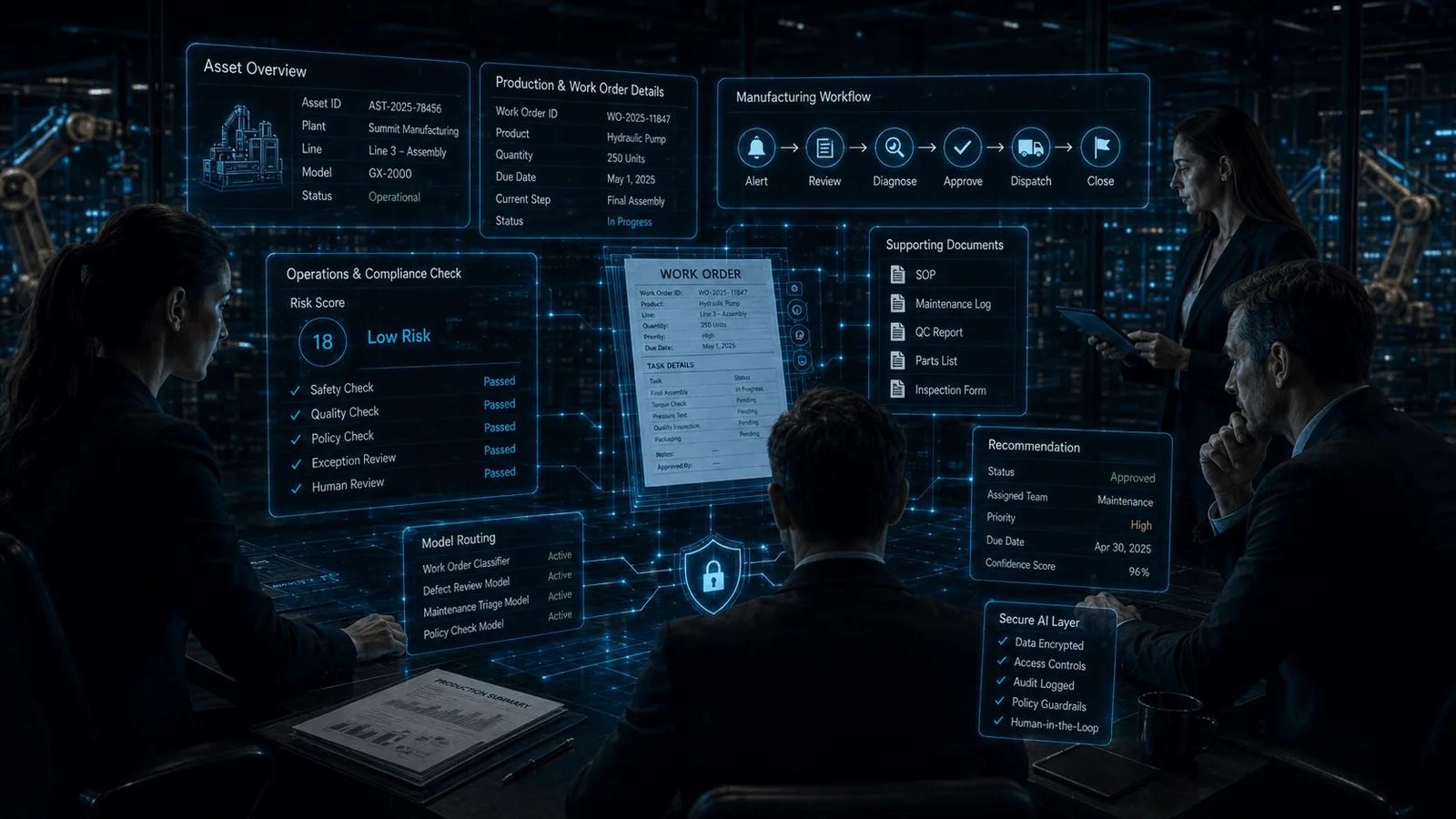
Manufacturing and factory operations
Put agentic AI to work across factory operations without losing control.
Sovereign SLM Labs helps manufacturers build private AI agents and task-specific Small Language Models around their own equipment, work instructions, quality standards, maintenance history, production records, and operating systems.
Private AI for manufacturing keeps plant data, asset context, prompts, outputs, and audit records inside controlled infrastructure.
Manufacturing AI agents support factory operations, maintenance, quality, production planning, frontline assistance, supply chain, warranty, and field service.
Task-specific SLMs fit language-heavy workflows where the answer must be grounded in approved equipment, process, and quality context.
The challenge
Manufacturing teams already have plenty of data. The difficult part is that the information needed to make a decision is often spread across machines, MES platforms, maintenance systems, quality applications, ERP software, engineering documents, spreadsheets, and the experience of a few senior employees.
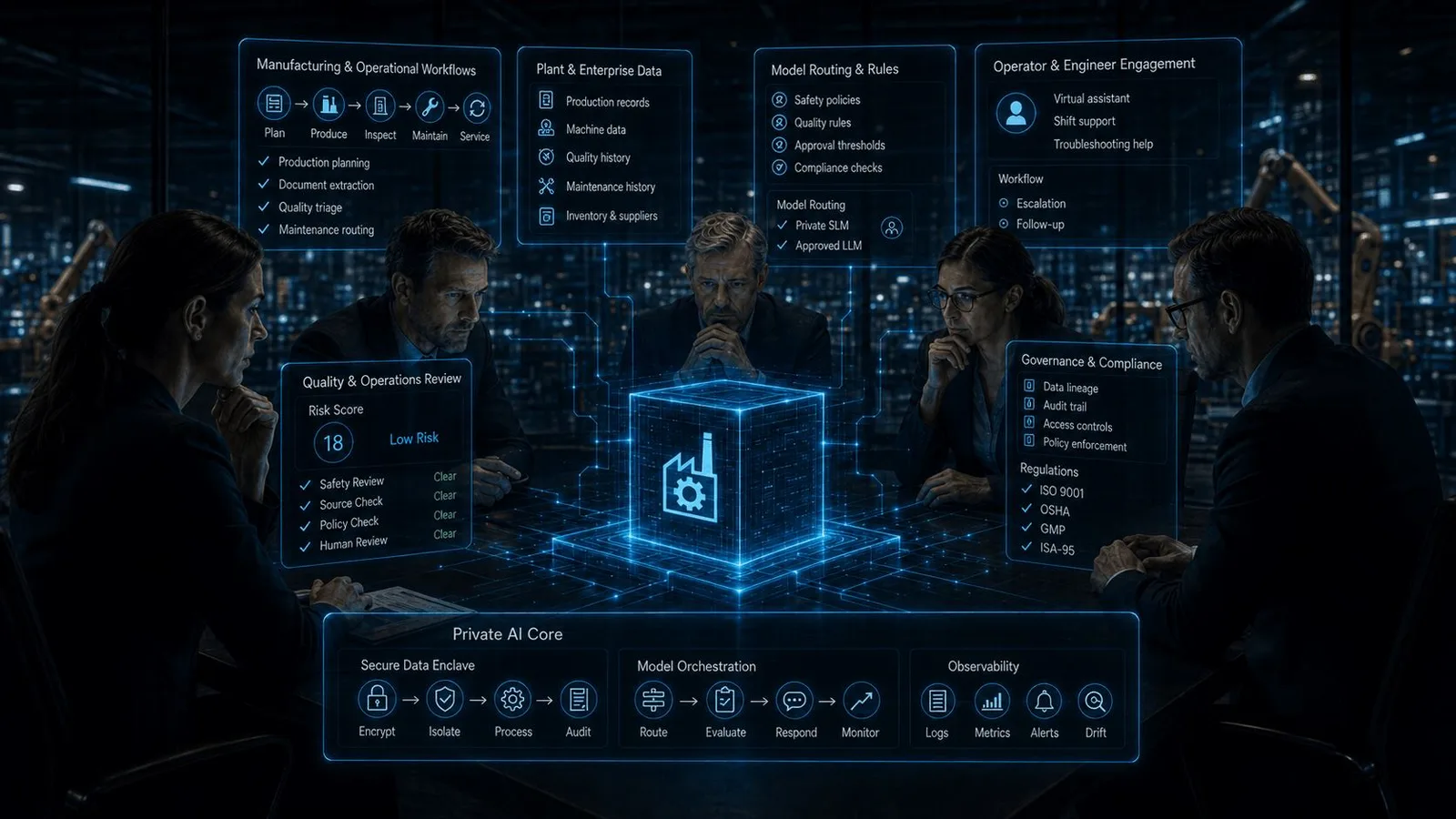
Production issues may require context from MES, ERP, SCADA, historians, QMS, CMMS, EAM, PLM, shift reports, and SOPs.
Plants often depend on experienced technicians, engineers, supervisors, and operators who understand unusual equipment behavior.
A single failure can disrupt schedules, delay orders, increase overtime, create scrap, and put customer commitments at risk.
Defect investigations often need batch data, machine settings, inspection records, supplier files, and previous incident context.
Answers need to reflect actual equipment, control limits, product specifications, maintenance policies, SOPs, and escalation rules.
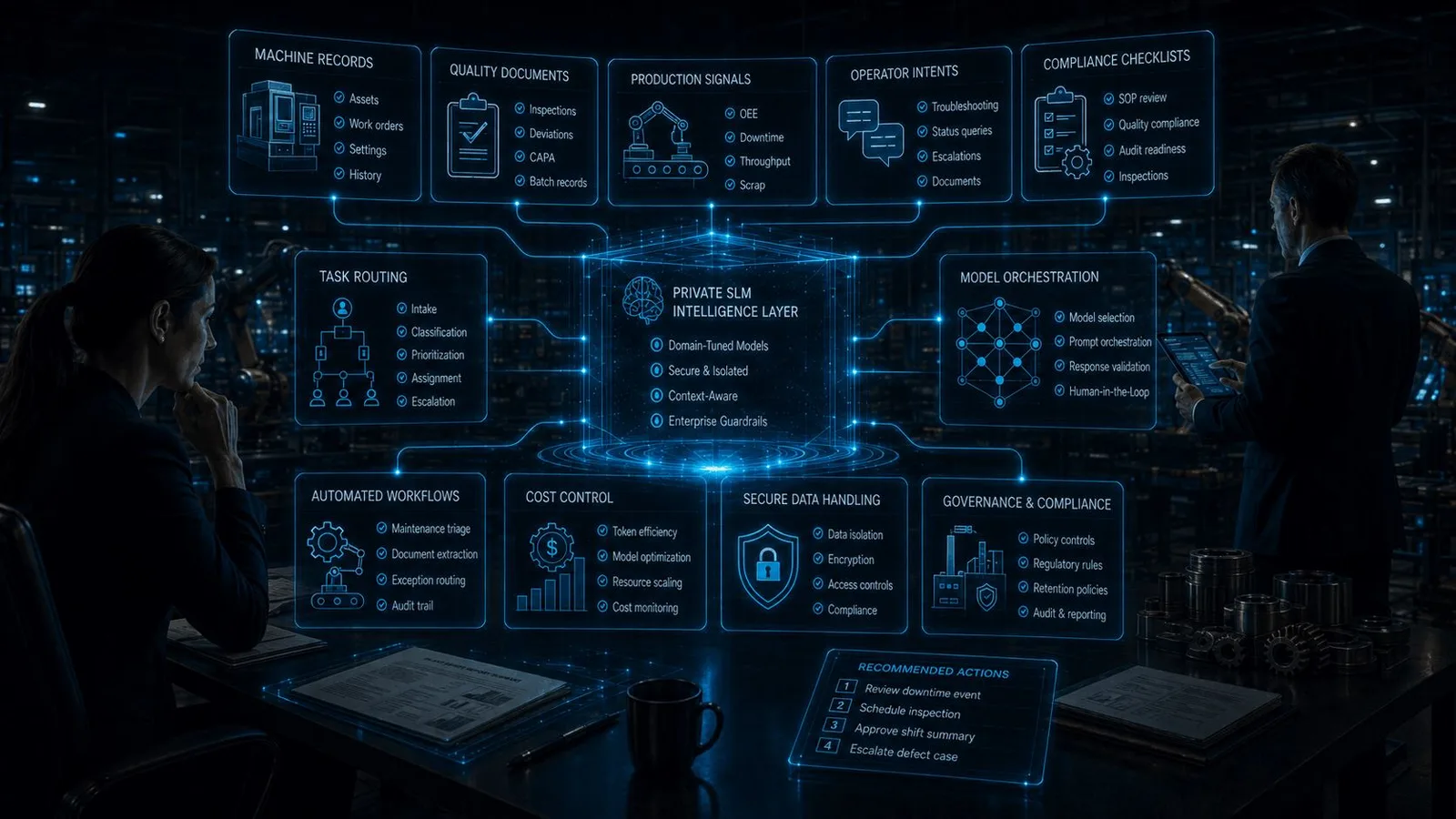
The SLM advantage
Manufacturing AI should not depend on one model doing everything. A dependable architecture combines predictive models for equipment signals, computer vision for inspection, rules engines for safety limits, task-specific SLMs for language workflows, private RAG for plant knowledge, and human review for accountable decisions.
Defined tasks: maintenance request classification, SOP retrieval, shift-report summarization, quality issue extraction, supplier exception routing, and investigation preparation.
Approved knowledge: equipment manuals, work instructions, FMEA documents, maintenance logs, quality procedures, control plans, incident reports, and supplier specifications.
Deployment control: on-premises, industrial edge, private cloud, controlled VPC, dedicated environments, air-gapped settings, or hybrid plant-and-cloud architecture.
Detailed use cases
The strongest opportunities are operationally specific, measurable, and grounded in plant data, approved procedures, equipment context, and clear escalation rules.
01
Help leaders investigate output loss, downtime, bottlenecks, order risk, and shift-to-shift performance through source-backed questions.
02
Turn anomaly signals into coordinated maintenance action by retrieving context, procedures, parts, and prior repair history.
03
Gather evidence across inspection records, batch data, supplier information, process settings, and similar incidents.
04
Investigate disruptions caused by machine availability, labor constraints, material shortages, urgent orders, or quality holds.
05
Retrieve the correct procedure based on user, asset, task, line, product, and operating condition.
06
Turn notes, plant events, work-order status, and quality alerts into consistent handover briefs.
07
Help planners and buyers respond to shortages, supplier delays, demand changes, and at-risk orders.
08
Review specifications, certificates, inspection results, deviations, complaints, and corrective-action responses.
09
Organize service reports, customer emails, dealer records, claim forms, repair documents, and product histories.
10
Prepare technicians with product history, service instructions, part information, previous failures, and current case context.
11
Assist engineers with specifications, automation notes, requirements, technical documentation, and change-impact analysis.
12
Give employees one governed way to search SOPs, manuals, maintenance records, shift logs, quality documents, FMEA libraries, engineering files, and supplier specs.
Operations layer
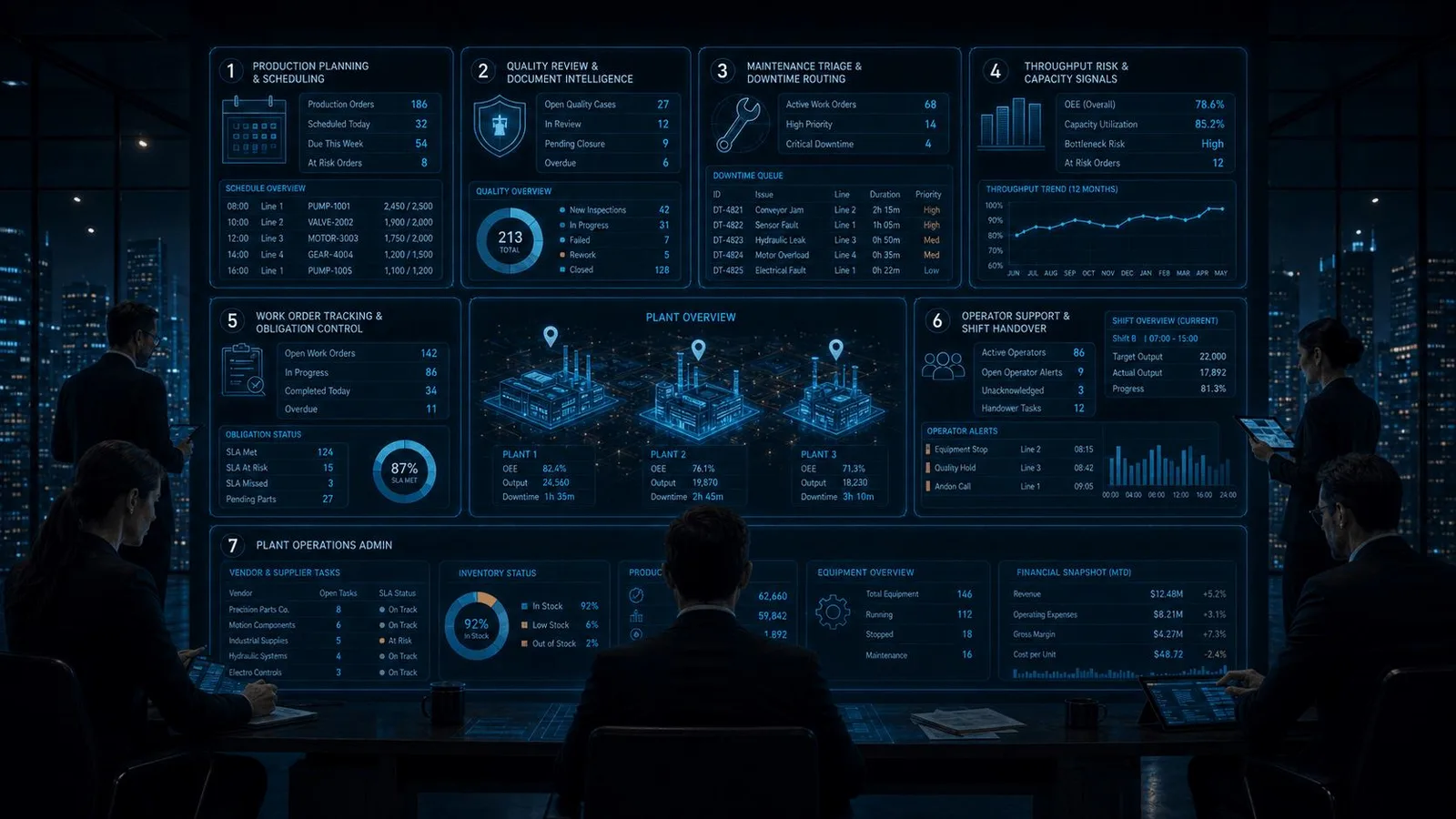
A useful manufacturing AI system should help teams move work through alerts, reviews, diagnosis, approvals, dispatch, inspections, maintenance follow-up, quality containment, supplier exceptions, and shift handover.
Operators get faster SOP search, status answers, troubleshooting support, and escalation paths.
Maintenance teams get clearer alerts, relevant history, parts context, and work-order preparation.
Quality teams get defect summaries, evidence gathering, similar-case search, and containment support.
Planners get schedule-risk signals, material checks, exception summaries, and approval-ready options.
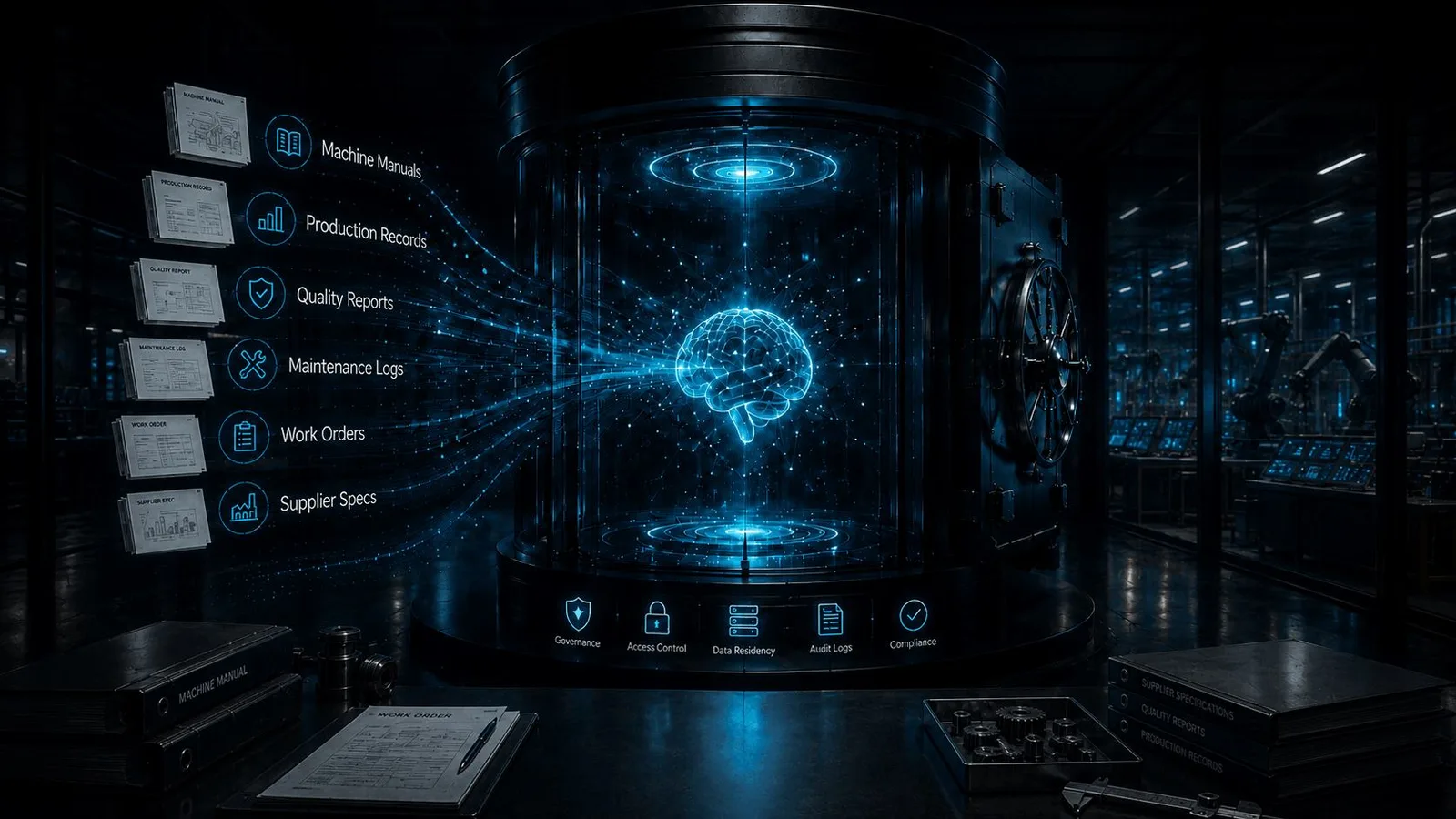
How we help
We begin with the workflow, not the model. The first questions are practical: where is work slowing down, what information is hard to find, what can the agent safely do, which decisions need approval, and what result can be measured?
We identify manufacturing workflows where private AI can create measurable operational value.
We build agents that retrieve plant context, read documents and logs, query approved systems, investigate exceptions, and record every action.
We adapt models using approved SOPs, equipment documentation, maintenance history, shift reports, quality records, engineering data, and incident cases.
We route each task to the right model or system based on risk, complexity, data sensitivity, latency, and accountability.
We help deploy manufacturing AI close to operations when latency, data residency, connectivity, IP protection, or plant constraints require it.
We build secure knowledge systems over approved manufacturing information with source traceability and role-based access.
Agents can connect with approved MES, ERP, SCADA, historians, CMMS, EAM, QMS, PLM, LIMS, warehouse, service, and document systems.
We design role-based access, plant and asset permissions, action limits, output validation, confidence thresholds, and human approvals.
Architecture
A strong manufacturing AI architecture separates data access, model selection, deterministic limits, agent actions, source traceability, and human oversight. That separation matters most when workflows touch equipment, safety, quality, customer commitments, or regulated records.
Approved manufacturing data includes production records, machine and asset information, quality data, maintenance history, engineering documents, supplier files, and inventory data.
Task and risk router classifies the request, identifies the asset, evaluates sensitivity, selects the right model, and determines approval requirements.
Specialized models combine predictive maintenance, computer vision, task-specific SLMs, private RAG, rules engines, and controlled larger models only when needed.
Structured outputs include shift summaries, work orders, quality investigations, maintenance recommendations, supplier-exception reports, production-risk alerts, and audit records.
Governance note
AI agents should support operational teams. They should not independently alter safety-critical controls or execute high-risk equipment actions without approved deterministic protections, access controls, tested procedures, and accountable human oversight.
Plant, line, asset, and role-based permissions
Source traceability and structured output validation
Human approval for safety, quality, and production exceptions
Audit logs, model versioning, drift monitoring, and change control
Related reading
These pages expand the architecture patterns behind local deployment, model routing, private RAG, and cost-aware SLM strategy.
Workshop
You do not need to make the entire factory autonomous on day one. Start with one workflow where teams already lose time: maintenance investigation, shift handover, quality triage, SOP search, production reporting, supplier exceptions, or warranty case review.
Identify the right first manufacturing workflow for private SLMs.
Assess data, integrations, edge needs, governance, and safety boundaries.
Build a practical roadmap for broader plant and enterprise adoption.
FAQ
Agentic AI in manufacturing refers to AI systems that can interpret an operational objective, retrieve industrial context, investigate an issue, complete approved workflow steps, and escalate exceptions instead of only responding to questions.
Manufacturing AI agents are specialized systems that support workflows such as production monitoring, maintenance, quality, planning, frontline guidance, supply-chain exceptions, warranty operations, and field service.
A copilot generally assists an employee with information and recommendations. An AI agent may also complete approved workflow actions, coordinate systems, create tasks, and monitor the outcome.
A manufacturing SLM is a smaller language model adapted for a focused industrial workflow, such as maintenance classification, SOP retrieval, shift-report summarization, or quality-case preparation.
SLMs do not normally replace time-series predictive-maintenance models. They can interpret alerts, retrieve maintenance history, explain findings, locate procedures, and coordinate the response.
Agents may support monitoring and approved low-risk workflows. Safety-critical equipment actions should remain protected by industrial control systems, deterministic safety rules, access controls, and accountable human authorization.
Strong starting points include maintenance triage, SOP search, shift handovers, quality-case summarization, production reporting, supplier-document review, and warranty processing.
Yes. Depending on the model and use case, SLMs and private RAG systems can run on-premises, at the industrial edge, in private cloud, or through a hybrid architecture.
Yes. Agents can connect with MES, ERP, CMMS, EAM, QMS, PLM, historians, supply-chain platforms, service-management applications, and other approved systems through controlled APIs and integration layers.
Use trusted retrieval sources, structured outputs, deterministic validations, source citations, equipment context, confidence thresholds, restricted actions, and human review.