Intelligence Layer | Specialist Models & Smarter Routing

Model & Intelligence Engineering

Your business does not need the biggest AI model for every task. It needs the right intelligence for the work.

Discuss Your Model Engineering Use Case
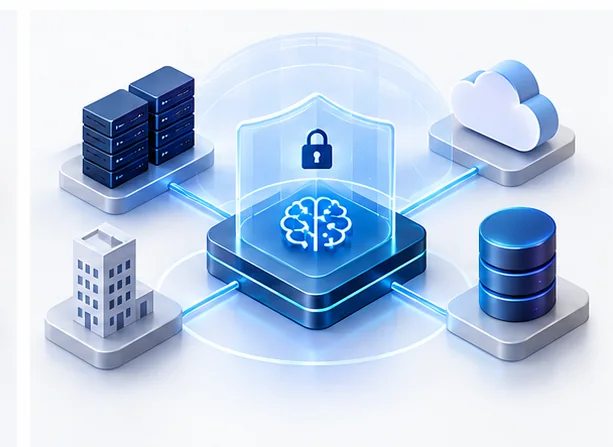
Illustration: A protected enterprise intelligence layer connected to private infrastructure, cloud and data

An AI model might understand natural language, but that does not mean it understands your claims rules, maintenance terminology, fund procedures, product catalog or internal policies. And even a capable model becomes expensive when every request is sent through the same long prompt and premium inference endpoint.

At Sovereign SLM Labs (SSLM), we engineer the intelligence layer that sits between enterprise workflows and AI models. We select and adapt Small Language Models (SLMs), build specialist model pipelines, design model orchestration and AI harnesses, and route each task according to accuracy, risk, privacy, latency and cost.

Some tasks belong with a focused private SLM. Others need an approved domain model, retrieval from authoritative enterprise knowledge, a deterministic rules engine or a more capable language model. Our job is to make those choices deliberate, measurable and governable.

The goal is not more model calls. It is more reliable work completed, with enterprise control over how the intelligence operates.

Explore all enterprise AI services →

The challenge: one general-purpose model cannot be your entire AI strategy

The fastest way to launch an AI pilot is often to connect a powerful general-purpose model to a prompt. That can be a useful starting point. It is rarely the whole architecture an enterprise should scale.

Consider a financial operations team handling thousands of documents. One request might be a simple classification. Another might require extracting thirty fields from a claim. A third might involve comparing evidence against an effective-dated rule. A fourth could require complex reasoning about an unusual exception. Routing all four through one large model ignores the differences in task complexity, accountability and cost.

It can also introduce practical problems: inconsistent structured outputs, unnecessary token consumption, long response times, limited data residency options, model provider dependency and difficult-to-explain decisions.

SSLM approaches the problem differently. We begin with the work the model must perform, define how correctness will be tested, and build a portfolio of models and supporting components around that need. We use model sophistication where it adds value, not as a substitute for engineering discipline.

What is Model & Intelligence Engineering?

Model & Intelligence Engineering is the practice of selecting, adapting, combining, evaluating and optimizing AI models for defined business workloads. It includes Small Language Model development, domain-specific fine-tuning, inference optimization, intelligent model routing, model orchestration and the control logic that determines when each type of intelligence should be used.

The model is only one part of this layer. Reliable outcomes often depend on how the model receives context, how its outputs are validated, how exceptions are handled, how permissions are enforced and how quality changes over time.

For SSLM, this discipline is model-neutral and business-led. We can work with open-weight SLMs, proprietary models, specialist machine learning models, embedding and reranking models, deterministic services and larger language models when the business case justifies them. We do not assume that fine-tuning or building a new model is always the right answer.

Our Model & Intelligence Engineering services

Capability 01

AI Harnessing & Model Orchestration

Connect the models, tools, context and controls needed to complete the task.

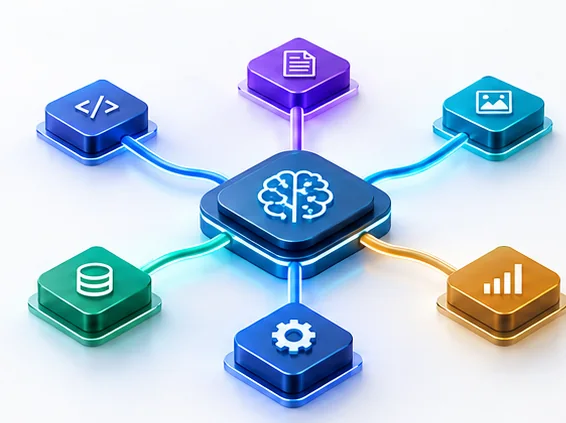
Illustration: AI model connected to code, documents, images, data, tools and analytics

A model alone cannot decide whether an employee is authorized to read a document, whether a price needs an effective-date check or whether an agent should stop and request approval. Those decisions belong to the application and control layers surrounding the model.

We engineer AI harnesses that organize context, retrieval, prompts, model calls, tools, validation, memory and workflow state into a repeatable execution pattern. This can include single-model workflows, multi-model pipelines, tool-enabled agents and orchestration that combines AI with traditional software.

Depending on the workload, this may involve:

  • Prompt and context engineering, including versioned system instructions, schema-constrained outputs and task-specific context windows.
  • Retrieval and grounding across approved enterprise knowledge, with access checks applied before protected content reaches a model.
  • Model gateways, orchestration graphs, function calling, structured tool interfaces and Model Context Protocol (MCP) integrations where appropriate.
  • Stateful execution, bounded retries, timeouts, fallbacks, error handling, idempotency and human approval checkpoints.
  • Model-level and workflow-level tracing, cost attribution, response validation and regression evaluation.
  • Guardrails for data handling, sensitive actions, output formats and policy enforcement outside the probabilistic model.

For example, a distributor claim workflow may use an SLM to read a claim narrative, an extraction model to structure the supporting document, a rules service to calculate the difference and a reviewer to approve disputed cases. The harness coordinates those parts without asking a language model to invent the arithmetic or approve the transaction.

What this delivers: A controlled intelligence workflow that is testable, observable and easier to improve than a chain of loosely connected prompts.

For more on the underlying control patterns, read our AI Harness Engineering guide.

Capability 02

SLM Fine-Tuning & Domain Adaptation

Teach a capable base model to perform your specific work more consistently.

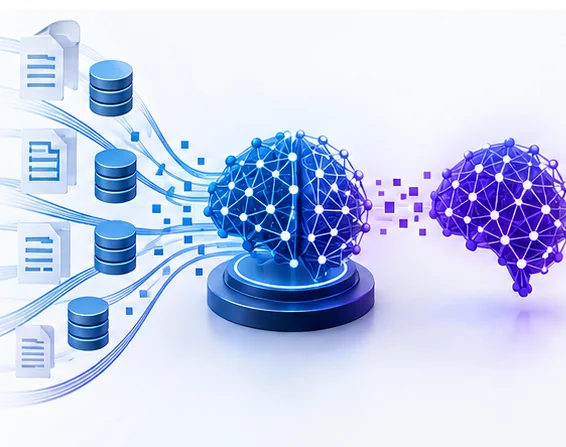
Illustration: Enterprise documents and data supporting adaptation of a specialist language model

A general model understands broad language. Your enterprise needs it to recognize local terminology, document structures, exception categories, approved response formats and the distinctions that matter in your industry.

We help organizations decide whether that gap is best closed through better prompting, Retrieval-Augmented Generation (RAG), supervised fine-tuning or another approach. When fine-tuning is justified, we build the data and evaluation pipeline rather than treating training as a one-time experiment.

Our engineering work can include:

  • Data discovery, permissions review, privacy checks, deduplication and creation of representative training, validation and holdout datasets.
  • Domain labeling, annotation guidelines, expert review and careful treatment of rare but business-critical exceptions.
  • Parameter-efficient fine-tuning (PEFT), including LoRA and QLoRA, and supervised fine-tuning (SFT) when supported by the model and infrastructure.
  • Domain-adaptive continued pretraining, distillation or preference optimization where there is a demonstrated need, sufficient data and suitable rights to use the source material.
  • Structured-output adaptation for classification, entity extraction, document parsing, summarization, terminology normalization and approved response styles.
  • Before-and-after evaluation, overfitting checks, data leakage testing, model versioning and rollback-ready release packages.

Imagine a specialist model that needs to distinguish between an ordinary insurance claim document and an exception requiring manual review. Fine-tuning can help it learn the distinctions from approved examples, while the policy decision itself remains governed by validated rules and human oversight.

What this delivers: Domain-adapted models measured against your workflow, with documented training provenance and clear evidence of whether tuning actually helped.

Capability 03

Small Language Model Engineering

Design focused, efficient intelligence for tasks that happen every day.

Illustration: Specialist small language models serving document, operations, retail, finance and security tasks

Small Language Models are not simply smaller substitutes for frontier LLMs. Used well, they are components selected for a particular workload, such as intent classification, structured extraction, first-pass triage, document tagging or internal knowledge assistance.

We benchmark candidate SLMs against your datasets, languages, document formats, compute capacity and response-time requirements. That includes checking whether a compact model is genuinely sufficient or whether the task needs retrieval, a different architecture or escalation to a more capable model.

Our SLM engineering capabilities cover:

  • Workload profiling and base-model selection across open-weight and commercially available models, subject to licensing and deployment requirements.
  • Tokenizer and context-window considerations for multilingual content, industry acronyms and large enterprise documents.
  • Adaptation for constrained JSON outputs, information extraction, categorization, short-form generation and task-specific reasoning.
  • Compression and quantization, including formats and methods such as GGUF, GPTQ or AWQ where appropriate, with accuracy checks after conversion.
  • Hardware-aware inference across CPU, GPU, private cloud, on-premises and supported edge environments.
  • Packaging, model registry integration, reproducible builds, version management and operational handover.

We do not position every SLM as cheaper or better in every situation. Hardware utilization, concurrency, engineering effort and accuracy all matter. The right answer comes from measuring real task performance and end-to-end operating cost.

What this delivers: Practical specialist models that are appropriately sized, privately deployable where required and supported by a repeatable evaluation process.

Explore our SLM vs LLM comparison for a wider discussion of when smaller models are a good fit.

Capability 04

Model Routing & Intelligence Optimization

Send each request to the least complex approved system that can do it well.

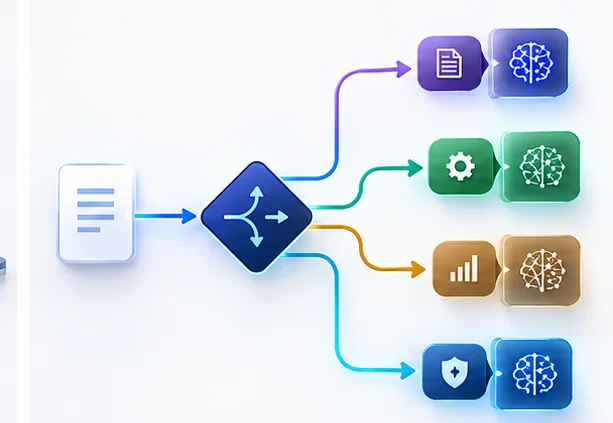
Illustration: A request routed to different specialist models according to its task

Model routing is not a random load balancer across AI providers. A useful enterprise router understands what work has arrived, which models are capable of performing it, what data is allowed to leave the environment and how much risk the organization is willing to accept.

We build intelligent model routing policies using combinations of task type, sensitivity, user entitlements, complexity, context size, model capability, latency objectives, capacity, cost and calibrated quality signals.

A routing design may include:

  • Deterministic routing for known task categories, restricted datasets and approved business rules.
  • A lightweight classifier or learned router for intent, complexity and specialist model selection.
  • Policy-aware gating that blocks disallowed models or locations before an inference request is issued.
  • Confidence and uncertainty checks calibrated against held-out examples, with abstention and human review when evidence is insufficient.
  • Cascaded inference, where a focused model handles routine cases and more capable models receive only permitted exceptions.
  • Fallbacks for unavailable models, overload, timeouts or output validation failures, without silently weakening data policies.
  • Versioned routing policies, traffic splitting, shadow evaluation and controlled A/B testing.

A sensitive hedge fund compliance document, for example, should not be sent to a public frontier endpoint merely because it looks difficult. The router must first apply data residency, contractual and approval constraints. It can then choose an authorized private specialist model, an approved private larger model or human escalation.

What this delivers: A controlled model portfolio with clearer quality, privacy and cost decisions for every workflow.

Capability 05

Model Performance & Cost Optimization

Reduce AI cost without quietly reducing the quality of the work.

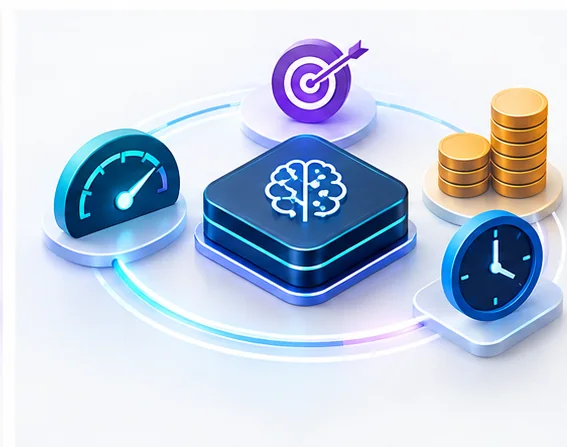
Illustration: Model performance balanced against accuracy, latency and operating cost

Token prices tell only part of the story. A low-cost model that fails repeatedly, produces unusable outputs or forces employees to redo the task may cost more than a stronger model that gets it right the first time.

We profile end-to-end cost per successfully completed task alongside accuracy, reliability, throughput and latency. From there, we optimize the model and serving stack where the evidence supports it.

Typical techniques include:

  • Quantization and precision selection, evaluated against task quality and hardware support.
  • Dynamic batching, continuous batching, concurrency controls, memory management and KV-cache optimization.
  • Inference serving options such as vLLM, llama.cpp, Hugging Face TGI, ONNX Runtime or other compatible runtimes, selected for the model and environment.
  • Prompt and context reduction, efficient retrieval, reranking and caching with appropriate freshness and data-isolation controls.
  • Model cascading, tool-call limits, retry budgets, token budgets and workflow-aware rate limiting.
  • Capacity planning for accelerator utilization, peak demand, p50 and p95 latency, error budgets and autoscaling constraints.
  • AI FinOps dashboards showing workload consumption, cost drivers, quality regressions and opportunities for consolidation.

We benchmark trade-offs rather than assuming an optimization is harmless. A quantized model may be faster and smaller but lose accuracy on certain document types. A cached response may be cheap but become incorrect after a policy update. Both effects have to be measured.

What this delivers: Better visibility and control over inference economics, with performance targets tied to business outcomes.

Read our article on enterprise LLM cost optimization and AI FinOps.

Capability 06

Custom Enterprise Intelligence Layers

Turn a set of AI models into a capability your enterprise can own and reuse.

Illustration: A protected enterprise intelligence layer connected to private infrastructure, cloud and data

The most valuable enterprise intelligence often lives outside the model weights. It lives in the organization's terminology, approved knowledge, decision criteria, access policies, integrations and accumulated expertise about real exceptions.

We design reusable enterprise intelligence layers that bring these assets together without locking every workflow into a single model provider or application. The layer can serve internal assistants, document intelligence pipelines, decision-support tools and approved agent workflows through stable APIs.

Depending on the organization, the architecture may include:

  • A model gateway and registry for approved SLMs, specialist models and larger-model endpoints.
  • Enterprise taxonomies, business ontologies, entity normalization, terminology services and knowledge graph integration.
  • Secure RAG and context services, embedding and reranking models, metadata filters and source provenance.
  • Policy engines, identity-aware access controls, tenant isolation, data-classification checks and routing constraints.
  • Standard task APIs, validated output contracts, model fallback policies and human-review interfaces.
  • Evaluation datasets, feedback capture, drift monitoring and versioned knowledge and model releases.

A bank might reuse the same controlled document extraction and policy-grounding components across onboarding, servicing and compliance. An airline might share specialist terminology and maintenance-document retrieval across engineering support and operational knowledge applications.

What this delivers: A modular intelligence foundation that can evolve as business needs, models and regulations change, without rebuilding the full stack for every use case.

Choosing the right technique: prompts, RAG, fine-tuning, SLMs or larger models?

There is no reason to train a model to remember a policy that changes every month. Equally, adding more retrieved pages will not automatically teach a model to return a difficult structured format consistently. The approach should match the nature of the problem.

Choosing an AI technique for your business workload
Business need Often the right starting point What to verify
A stable format, extraction pattern or classification task Structured prompting, rules, or a specialist SLM Field accuracy, edge cases, format validity
Answers based on changing internal documents or policies Permission-aware RAG with source citations Retrieval quality, document freshness, access enforcement
Repeated task behavior that a base model performs inconsistently SFT or PEFT fine-tuning on approved examples Improvement on unseen cases, drift, operational complexity
Complex, unusual or ambiguous reasoning An approved larger or specialist model, with escalation Correctness, evidence quality, sensitivity and cost
Exact calculations, entitlements or business-rule enforcement Deterministic services and policy engines Test coverage, effective dates, audit trail
Mixed work across different complexity levels A policy-aware model router and harness End-to-end success, quality at each route, safe fallbacks

In practice, useful solutions combine several of these. We document why a technique was chosen and when that decision should be revisited. That prevents expensive retraining where retrieval would suffice and prevents model prompts from replacing established controls.

How an intelligent enterprise model router works

A good router makes decisions in a defined order. Permission comes before model preference. Quality comes before cost savings.

  1. Understand the request. Classify the task, expected output, context length and business process.
  2. Apply enterprise policies. Check identity, data sensitivity, residency, permitted providers, tenant boundaries and model approval status.
  3. Identify capable options. Build a shortlist of deterministic services, SLMs, domain models and larger models that are allowed to handle the task.
  4. Choose the initial route. Consider measured task accuracy, latency, available capacity and expected inference cost.
  5. Assemble approved context. Retrieve relevant information through authorized channels and minimize unnecessary content.
  6. Run and validate. Enforce structured output contracts, business rules, citations and safety checks.
  7. Escalate when needed. Retry with limits, use a more capable approved model or request human review when confidence or validation fails.
  8. Capture feedback. Record a privacy-aware trace, model version, route, evaluation outcome, latency and cost so routing policies can improve.

A practical example: an enterprise claims or compliance queue

An incoming case needs a document type and priority. A focused private SLM classifies it. The case contains a set of amounts and dates, so a deterministic service validates those fields. An approved retrieval layer supplies the latest policy. If the case matches a familiar pattern, the system prepares a structured recommendation. If it contains contradictory evidence or a rare exception, it moves to an authorized larger model or a reviewer.

The end user sees one consistent workflow. Underneath it, each component does the work it is suited for. Sensitive documents do not cross a prohibited boundary, and a high-risk decision does not become automatic simply because the model sounds confident.

Reference architecture: the enterprise intelligence layer

Our model engineering architecture is intentionally modular. A typical pattern includes:

  1. Business application or AI agent: The authenticated workflow that requests an intelligence service.
  2. Identity and policy gateway: Tenant scope, roles, data classification, provider allowlists and usage entitlements.
  3. AI harness and orchestration: Task classification, context assembly, execution state, prompt templates, tools and retry boundaries.
  4. Intelligent model router: Policy-aware selection using capability, evaluated quality, latency, capacity and cost.
  5. Model portfolio: Specialist SLMs, fine-tuned domain models, embedding and reranking models, approved larger LLMs and classical ML where useful.
  6. Enterprise context services: Secure RAG, structured data, knowledge graphs, taxonomies and governed enterprise connectors.
  7. Validation and escalation: Schemas, deterministic calculations, source checks, exception rules and human review.
  8. Evaluation and operations: Model registry, versioned tests, tracing, drift detection, throughput monitoring and AI cost analytics.

This is a reference pattern rather than a fixed product stack. The final architecture depends on your security boundary, hardware, volume, existing platforms and support model.

The layer is designed to work with the implementation capabilities described in our AI Engineering & Forward Deployment practice and the wider Sovereign SLM Labs services portfolio. Production user interfaces, business-system integrations and infrastructure delivery remain distinct, complementary parts of the overall solution.

Evaluation is part of engineering, not a final demonstration

It is easy to say that a model is accurate after testing ten favorable prompts. Enterprise workloads need stronger evidence.

We work with domain owners to build evaluation datasets that reflect the actual workload, including common requests, ambiguous inputs, low-quality documents, multilingual examples, rare exceptions and situations where the correct answer is to abstain. We keep training and evaluation data separated and check for leakage from duplicated or near-duplicated records.

Our evaluation framework can include:

  • Task quality: Accuracy, precision, recall, F1, exact-match scores and field-level extraction quality where appropriate.
  • Groundedness: Evidence relevance, citation correctness, unsupported assertions and safe refusal when information is missing.
  • Structured reliability: JSON or schema validity, completeness, consistency and downstream validation failures.
  • Risk testing: Prompt injection resilience, unauthorized data access, sensitive-output leakage and policy-bypass scenarios.
  • Operational performance: p50 and p95 latency, throughput, timeout rates, concurrency and model availability.
  • Economics: Compute use, token consumption, retries, review effort and total cost per accepted task.
  • Change detection: Quality by dataset slice, model or prompt regression, data drift, evolving terminology and newly observed exceptions.

Where uncertainty estimates are used for routing, we test whether the confidence signals are actually calibrated. A model's self-reported confidence is not proof that its answer is correct. High-impact use cases still need appropriate human approval and existing business controls.

We define acceptance criteria before implementation and use them to decide whether a new model, fine-tune, routing policy or optimization is ready for controlled release.

Our delivery process: from workload to governed model operations

01. Understand the workload and set a baseline

We work with business owners and engineers to identify the exact tasks, documents, source systems, quality criteria, sensitivity constraints, volume and latency needs. We establish what the existing process costs and how a baseline model performs before promising improvements.

02. Evaluate model candidates and architecture options

We benchmark suitable SLMs, specialist models, larger models, retrieval strategies and deterministic alternatives against representative examples. We review licenses, hosting boundaries, hardware needs, data requirements and the trade-offs between prompt engineering, RAG and fine-tuning.

03. Build the domain data and engineering pipeline

Where adaptation is justified, we prepare approved datasets, labels, holdouts, training configurations and reproducible evaluation runs. We establish model and dataset versions, a documented release process and controls for sensitive training material.

04. Engineer the harness and routing logic

We connect model endpoints to the context, policy, validation and orchestration layers. We implement model selection, safe fallbacks, output contracts, bounded retries, exception handling and required human approval paths.

05. Optimize and test under realistic conditions

We run task-level quality evaluations, security scenarios, concurrency tests and cost benchmarks. We tune inference, context size, model allocation and hardware only when the measured quality and business requirements remain acceptable.

06. Release, transfer ownership and continuously improve

We deliver model cards or equivalent documentation, evaluation packs, versioned artifacts, routing policies, operating runbooks and monitoring requirements. We support controlled rollout and help the enterprise decide how models will be updated, reviewed and retired over time.

Typical deliverables: Model selection report | Evaluation dataset and test harness | Fine-tuned model artifacts where justified | Inference and routing architecture | Model gateway and orchestration specifications | Performance and cost benchmark | Security and governance controls | Deployment and operational handover.

Industry-specific intelligence, engineered for the work

Banking, financial services and investment operations

Financial institutions need models that understand complex documents and local business rules without turning AI output into an unchecked decision. Potential workloads include KYC and AML case triage, credit document extraction, payment exception classification, regulatory obligation mapping, investment document review and due diligence questionnaires. Specialist SLMs can prepare structured work, with approved rules and qualified reviewers retaining accountability.

Explore Private AI for Banking & Financial Services

Insurance and third-party administrators

Insurance teams work with policy schedules, endorsements, claims evidence, medical or repair documents, exclusions and inconsistent forms. Domain-adapted extraction and classification models can help with intake, claims routing, missing-information checks and document comparison. Rules engines and adjusters remain responsible for coverage and settlement decisions.

Explore Private AI for Insurance & TPAs

Aviation, airlines and maintenance operations

Aviation demands precision around technical vocabulary, maintenance manuals, operational procedures and revisions. Specialist models can classify technical records, normalize aircraft and component terminology, prepare maintenance knowledge responses from approved sources and prioritize operational exceptions. Grounded retrieval, revision control and human authority are particularly important in safety-sensitive workflows.

Explore Private AI for Aviation

Retail, FMCG and consumer products

In consumer products, AI may need to understand SKU hierarchies, distributor claims, schemes, trade promotions, returns and multilingual customer requests. Small task-specific models can extract or classify the messy inputs. Deterministic services can reconcile pricing, taxes, discount eligibility and effective-dated commercial rules.

Explore Private AI for Retail & Consumer Products

Healthcare, pharmaceuticals and life sciences

Health and life sciences workflows rely on controlled terminology, source provenance and careful human review. Model engineering can support prior authorization document classification, safety case intake, adverse-event narrative structuring, literature triage and regulatory content comparison. Sensitive records and clinically consequential outputs require approved safeguards and professional oversight.

Explore Private AI for Healthcare & Pharma

Manufacturing and industrial operations

Plant maintenance, quality events, inspection narratives and SOPs contain valuable domain language that generic models may not interpret reliably. Small models can help classify incidents, extract fault details and route maintenance requests. Retrieval and validation tie outputs back to current manuals and maintenance histories.

Explore Private AI for Manufacturing

Real estate and property operations

Lease clauses, service requests, tenant communications and maintenance documents lend themselves to domain extraction, classification and exception routing. A shared enterprise intelligence layer can normalize property terminology, retrieve approved lease terms and surface cases that need legal, financial or property-manager review.

Explore Private AI for Real Estate

Legal, compliance and regulated evidence workflows

Contract clause classification, legal intake, control-to-evidence mapping, policy change detection and document comparison benefit from specialist models, constrained outputs and provenance. AI can prepare a structured review, but legal advice, compliance sign-off and material risk decisions remain with qualified professionals.

Explore Private AI for Legal Services & ALSPs

Why Sovereign SLM Labs for enterprise model engineering?

We are model-neutral, not model-first

We do not begin by selling a single model or a fine-tuning package. We compare SLMs, LLMs, retrieval, traditional ML and rules based on the workload. Sometimes the best engineering decision is not to train anything.

We design around enterprise ownership

The intelligence developed from your processes and knowledge should remain under defined enterprise control. We consider data residency, model and dataset licenses, artifact ownership, access boundaries, portability and long-term support when selecting the stack.

We treat quality, latency, privacy and cost as one problem

An architecture is only useful when it works across all four. We establish measurable trade-offs, put constraints into the routing and harness layers, and evaluate costs per accepted business outcome rather than quoting model benchmarks out of context.

We connect the model to the wider system

Model engineering does not stop at training. It must fit the applications, enterprise data, deployment platforms, governance processes and teams that will operate it. We work across these boundaries while keeping the intelligence layer modular and reusable.

We plan for change from the beginning

Models, policies and enterprise information will change. Versioned datasets, evaluations, routing configurations, model registries, rollback options and ongoing monitoring help the organization improve without losing control of what is in production.

Frequently asked questions about Model & Intelligence Engineering

What is the difference between model engineering and AI application engineering?

Model engineering focuses on choosing, adapting, evaluating, routing and optimizing the intelligence used by a system. AI application engineering builds the user experience, integrations and workflow that put that intelligence to work. They are complementary, but they solve different technical problems.

What is a Small Language Model (SLM)?

A Small Language Model is a relatively compact language model intended to perform language tasks with less compute than many larger models. The exact size depends on the model family and use case. An SLM can be a strong fit for focused extraction, classification, short-form generation and other measurable workloads, but it is not automatically better for every problem.

Can an SLM be fine-tuned on our private enterprise data?

Potentially, yes. The process depends on your data rights, model license, security requirements, dataset quality and compute environment. We assess whether fine-tuning will add value, prepare approved training data, evaluate the results and document the deployment and governance requirements.

What is the difference between RAG and fine-tuning?

RAG supplies relevant external information to the model when a request is made. Fine-tuning adjusts model parameters using training examples. RAG is often better for frequently changing policies and reference content, while fine-tuning can improve repeated task behavior, formats and domain-specific patterns. Some workloads need both, and others need neither.

Does fine-tuning remove hallucinations?

No. Fine-tuning can improve performance on a defined task but does not guarantee factual correctness. Retrieval grounding, evidence checks, structured validation, abstention, evaluation and human oversight remain important where errors matter.

What does AI harness engineering mean?

AI harness engineering builds the runtime around a model, including prompts, context, tool calls, orchestration, permissions, validations, state, retries, evaluation and telemetry. The harness makes model behavior usable and governable as part of an enterprise system.

What is intelligent model routing?

Intelligent model routing selects an approved model or deterministic service for a task based on factors such as data sensitivity, workload type, assessed capability, latency, risk and cost. It can escalate difficult cases to a more capable authorized model or a human reviewer when necessary.

Can a model router use a frontier LLM only for difficult cases?

Yes, if the organization permits that model and data flow. A routing policy can direct routine cases to SLMs and escalate permitted exceptions. Restricted information must not leave its approved boundary merely because the request is complex.

Which technologies do you use for SLM training and inference?

The stack depends on the workload and enterprise environment. Options may include PyTorch, Hugging Face Transformers, PEFT and LoRA-style adaptation, model registries, vLLM, llama.cpp, TGI, ONNX Runtime and compatible infrastructure. We select components based on licensing, security, maintainability and benchmark results rather than a fixed vendor list.

Is a smaller model always cheaper to operate?

No. A smaller model may lower compute needs, but overall cost also depends on hardware utilization, throughput, retries, human review, training effort and the percentage of tasks completed correctly. We compare end-to-end cost per accepted outcome.

Can model engineering work with fully private or on-premises AI?

Yes, where the models, infrastructure and licensing support that deployment. We can engineer a model portfolio and routing layer for enterprise-controlled environments, including private cloud, on-premises and hybrid patterns. Any external provider usage is subject to explicit approval and data handling policies.

How do you measure whether a fine-tuned model is better?

We establish a baseline, hold out representative test data, evaluate task-specific metrics and compare before-and-after results, including failure cases. We also test latency, operational cost and regressions across critical categories. A fine-tune is useful only if it improves the agreed business outcome.

Do you build proprietary foundation models from scratch?

Training a large foundation model from scratch is not usually the most practical starting point for an enterprise workflow. Our primary focus is selecting, adapting, orchestrating and optimizing existing models, and engineering task-specific intelligence. If a specialized training program is justified, we assess its data, compute, cost, licensing and research requirements separately.
Build intelligence around your business, not the other way around

You may already have models in use, but no clear way to choose between them. Or you may have a valuable use case that needs a specialist SLM, a private routing layer or a more reliable approach to quality and cost.

Bring us the workflow, its data constraints and a few representative examples of what good looks like. We will help you determine which model capabilities are needed, what should remain deterministic, and how to build an intelligence layer your enterprise can maintain and control.

Start with the workload. Engineer for accuracy. Keep the intelligence under your control.

Talk to an AI Model Engineering Expert | Explore Our AI Services