Data remains fragmented
A shopper request may require product, ecommerce, CRM, loyalty, order, inventory, service, payment, and store context.
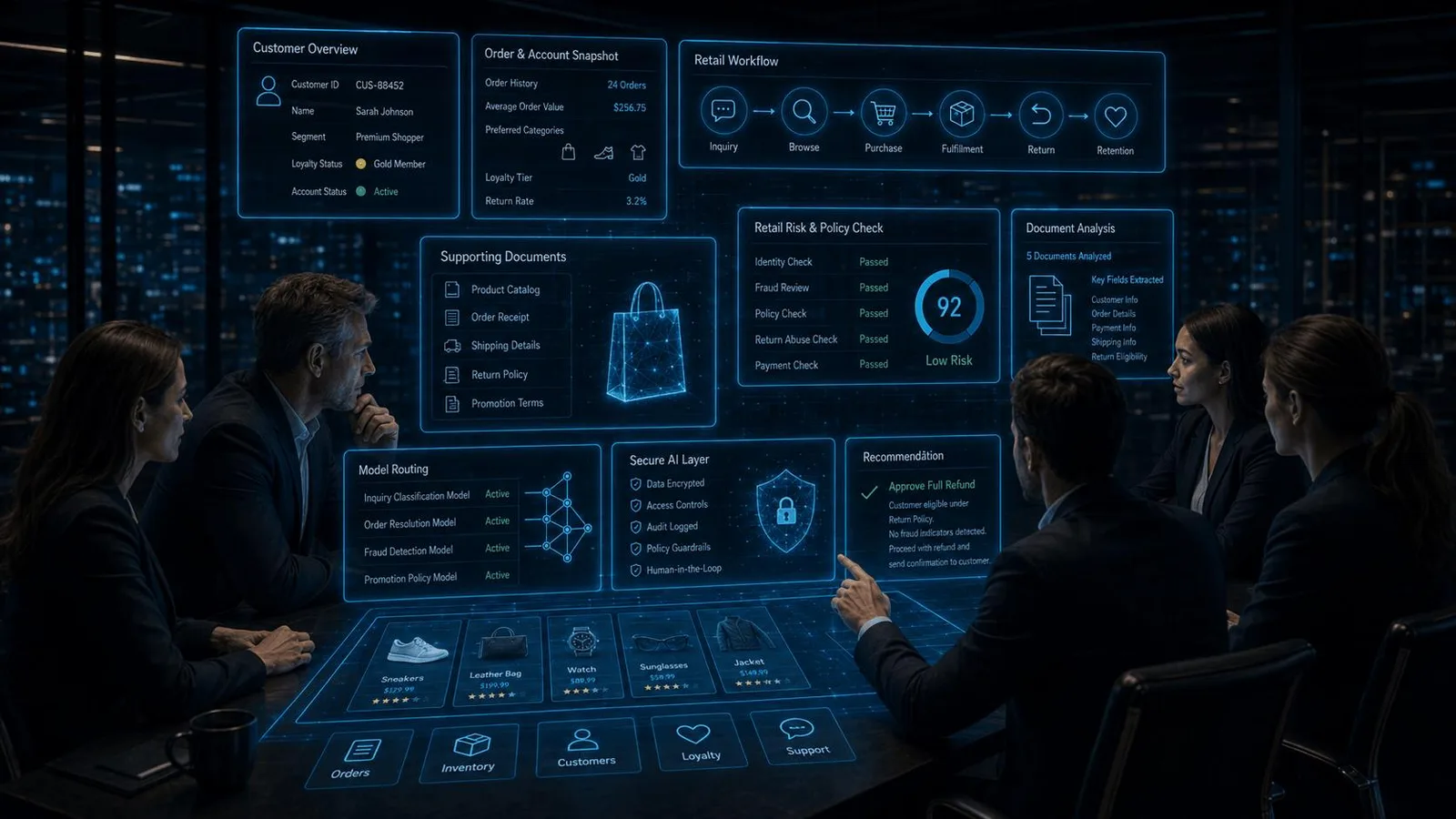
Retail and consumer products
Turn retail data and brand knowledge into AI intelligence you control.
Sovereign SLM Labs helps retailers and consumer-product companies build private AI agents and task-specific Small Language Models around their own products, customers, policies, brand standards, and operational workflows.
Private AI for retail keeps customer data, product intelligence, prompts, retrieval pipelines, outputs, and agent actions inside governed infrastructure.
Retail AI agents support product discovery, customer service, order support, returns, catalog enrichment, loyalty, merchandising, and inventory operations.
Task-specific SLMs fit focused workflows where answers must reflect approved product, policy, customer, brand, and commerce context.
The challenge
Retailers and consumer brands already have the data needed to sell, serve, merchandise, and operate better. The problem is that this information is scattered across product catalogs, commerce platforms, CRM systems, order-management tools, service conversations, loyalty programs, inventory systems, supplier files, and spreadsheets.
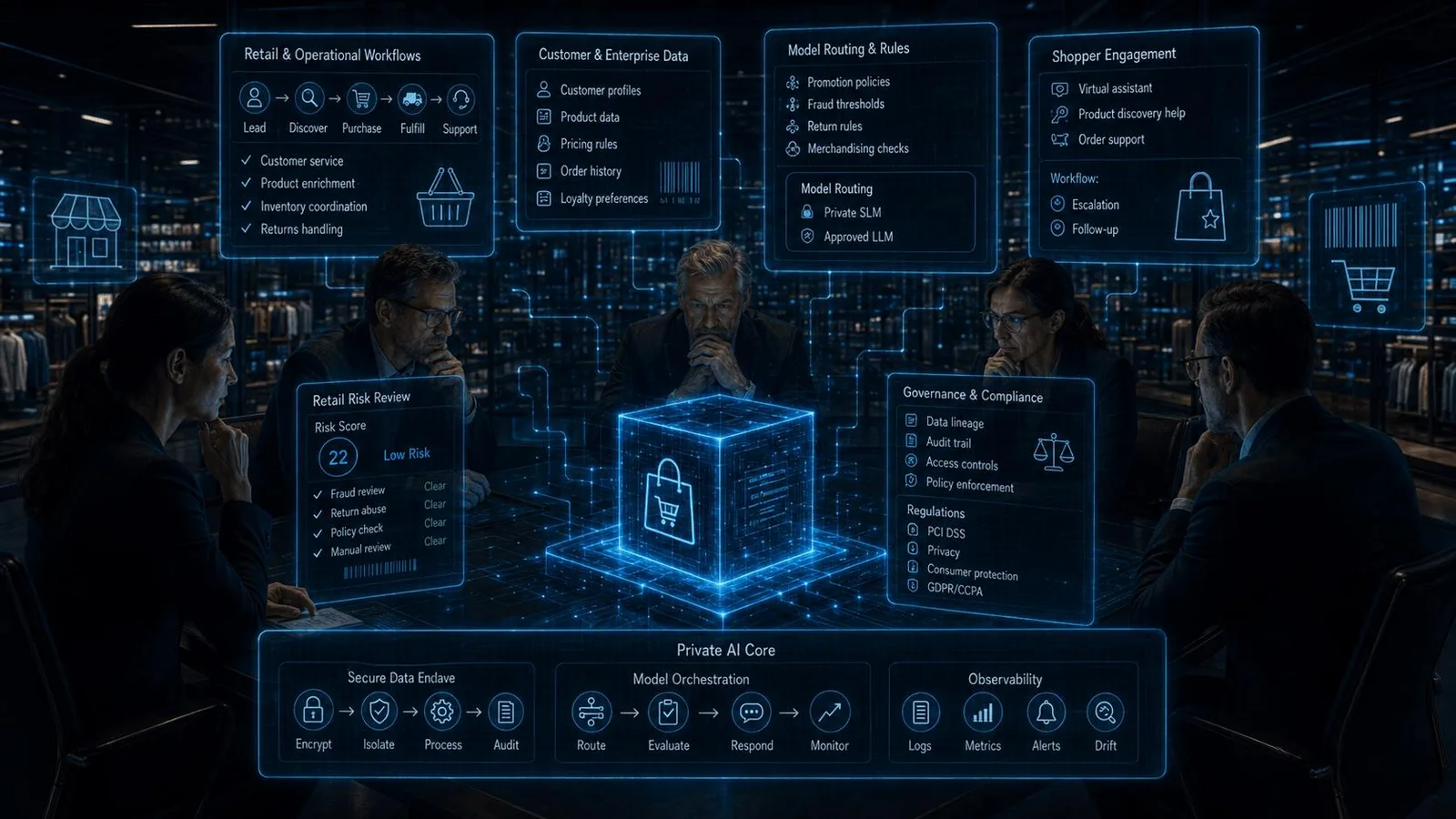
A shopper request may require product, ecommerce, CRM, loyalty, order, inventory, service, payment, and store context.
Order status, delivery dates, returns, refunds, sizing, subscriptions, loyalty benefits, and store questions surge during peak seasons.
Missing attributes and inconsistent taxonomy make products harder to find through site search, marketplaces, and AI shopping agents.
Delayed orders, inventory mismatches, promotion conflicts, out-of-policy returns, and supplier issues often require judgment.
Retail AI needs your return policy, product taxonomy, approved claims, tone, promotion rules, loyalty structure, and escalation paths.
The SLM advantage
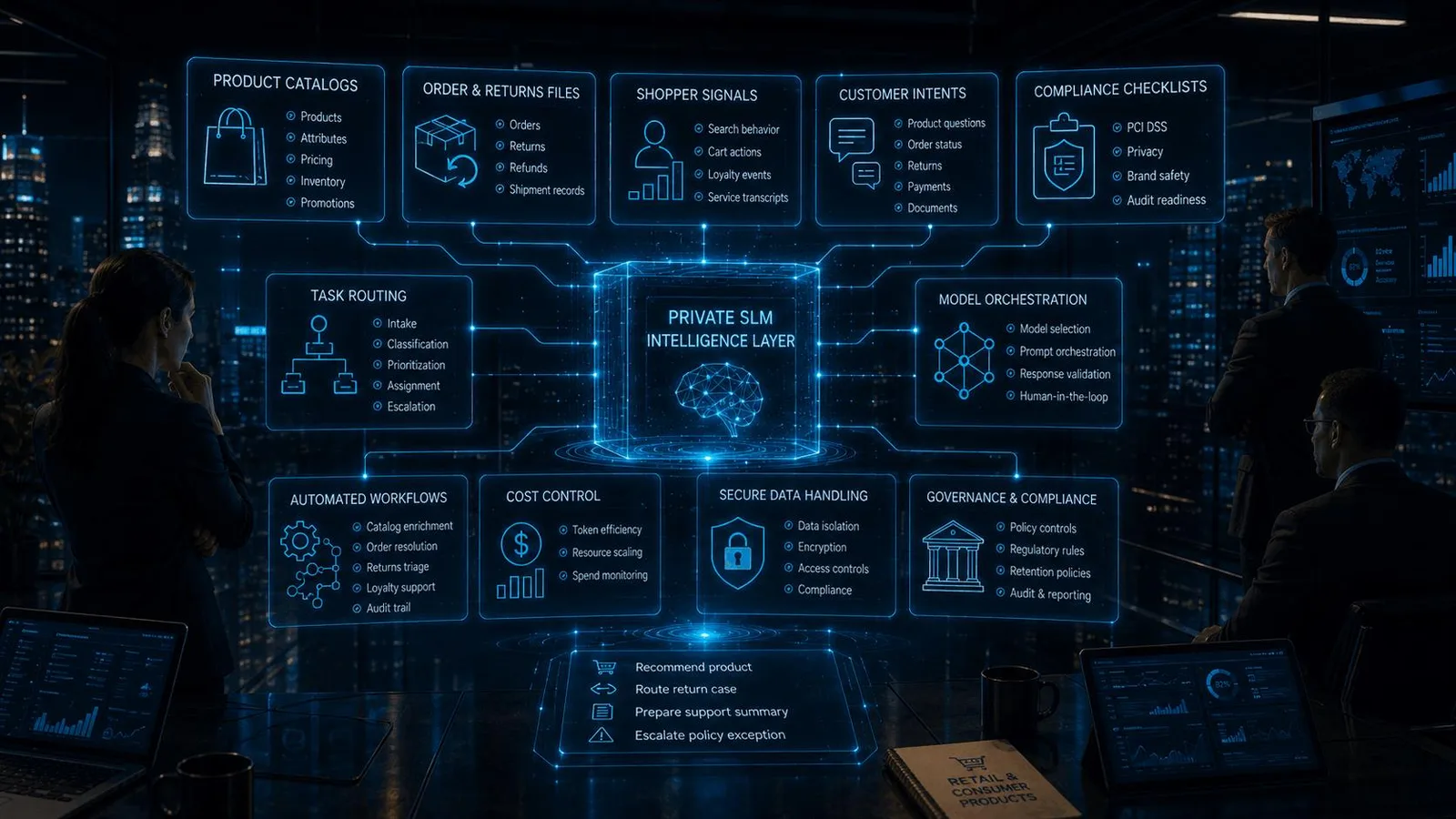
A reliable retail AI architecture should combine different technologies instead of forcing every workflow through one large language model. Predictive models, recommendation systems, fraud models, rules engines, task-specific SLMs, private RAG, agents, and human review each have a role.
Defined tasks: request classification, return-reason extraction, product attribute enrichment, customer-history summarization, order exception routing, and brand guideline checks.
Approved knowledge: catalogs, brand guidelines, refund policies, promotion rules, loyalty terms, store procedures, supplier documents, and historical resolution data.
Deployment control: private cloud, controlled VPC, on-premises environments, dedicated GPU infrastructure, region-specific hosting, store edge deployment, or hybrid architecture.
Detailed use cases
The strongest opportunities combine customer intent, product and policy context, live commerce data, business rules, and clear human-review boundaries.
01
Understand conversational requests and guide shoppers using catalog, availability, price, brand, and merchandising context.
02
Resolve approved support requests and maintain context across chat, email, voice, social, store, and messaging channels.
03
Identify missing product information and prepare controlled enrichments for ecommerce, marketplaces, search, and AI shopping systems.
04
Collect order, shipping, payment, customer, product, and policy context before taking approved resolution steps.
05
Help teams understand inventory exceptions and coordinate responses without replacing forecasting or optimization models.
06
Gather evidence for assortment, campaign, pricing, promotion, markdown, and merchandising decisions.
07
Create, validate, approve, communicate, synchronize, and archive CPG trade schemes through one controlled workflow.
08
Give teams fast access to product details, availability, policies, customer context, and operational procedures.
09
Coordinate approved outreach using customer context, loyalty rules, offer eligibility, consent, and communication preferences.
10
Turn reviews, surveys, service conversations, social feedback, return reasons, and store interactions into structured insight.
11
Perform first-level checks on descriptions, marketplace listings, campaign copy, FAQs, and retailer content before review.
12
Coordinate the intake of attributes, certifications, images, commercial terms, logistics data, and compliance documents.
13
Prepare and route questions about usage, ingredients, defects, warranty eligibility, replacement parts, and safety concerns.
Operations layer
A useful retail AI system should help teams move work through shopper inquiries, product discovery, order support, returns, refunds, catalog enrichment, inventory exceptions, loyalty service, product complaints, and human review.
Commerce teams get product discovery, catalog enrichment, recommendation support, and conversion insights.
Service teams get intent classification, policy matching, order context, and escalation-ready summaries.
Merchandising teams get product-performance summaries, promotion checks, and approval-ready exceptions.
Consumer care teams get complaint classification, product context, safety escalation, and quality-team routing.
How we help
We begin with the workflow rather than asking you to pick a model. We identify where customers or employees experience delays, which information is hard to retrieve, which decisions follow repeatable rules, which actions an agent can perform, and where human approval is required.
We identify practical opportunities across commerce, customer service, merchandising, stores, inventory, marketing, loyalty, and consumer care.
We build agents that understand requests, retrieve approved context, call authorized systems, complete approved actions, and escalate exceptions.
We adapt models using product catalogs, taxonomies, service conversations, return reasons, brand guidelines, commerce policies, loyalty rules, and workflow outcomes.
We route shopper intent, product retrieval, catalog enrichment, demand forecasts, fraud checks, return eligibility, and complex cases to the right system.
We help deploy retail AI in private cloud, controlled VPCs, on-premises infrastructure, region-specific hosting, store edge environments, or hybrid architectures.
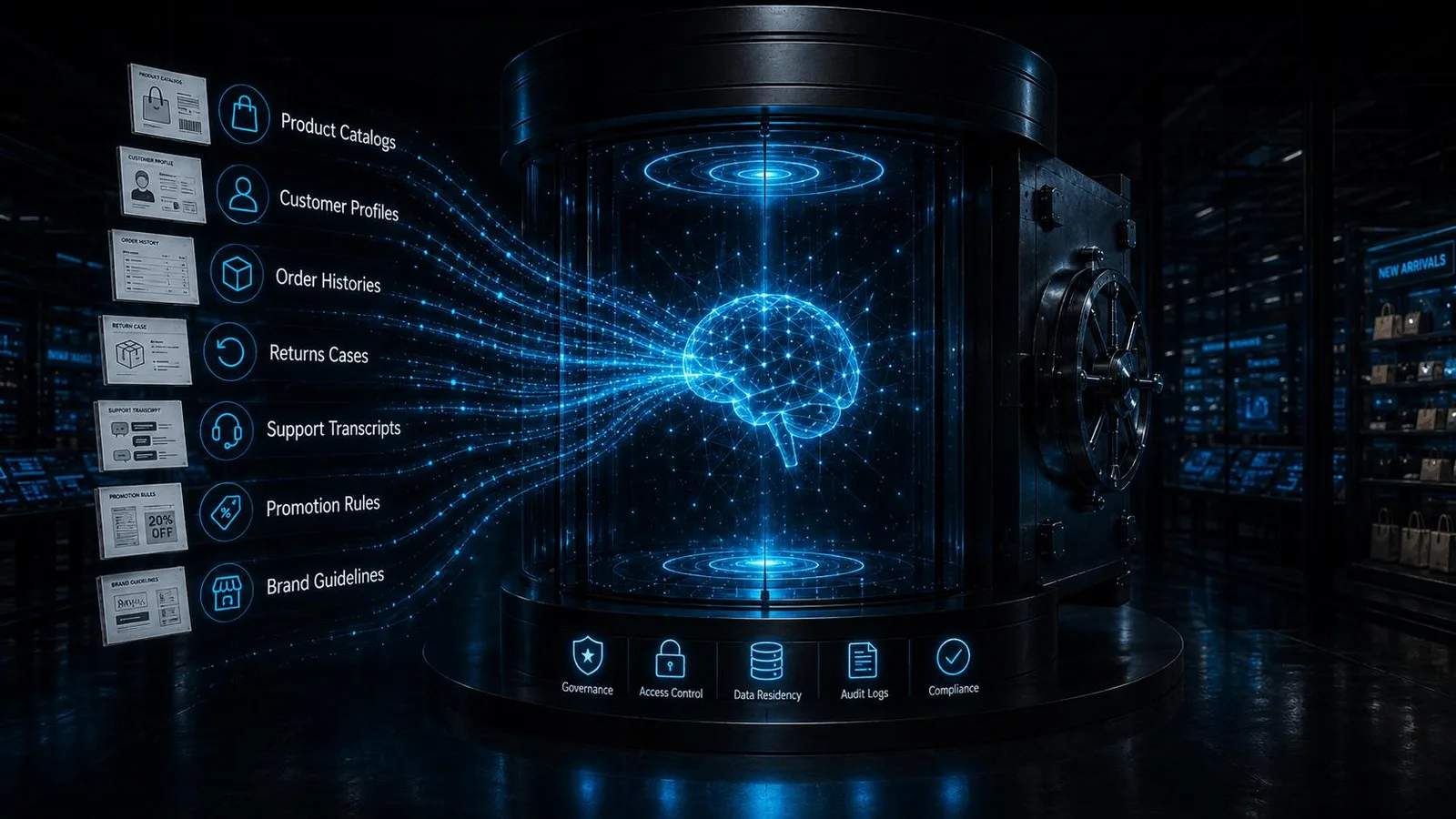
We build secure knowledge systems over approved product catalogs, brand guidelines, policies, service knowledge, loyalty terms, store procedures, and consumer-care libraries.
Agents can connect with ecommerce, POS, OMS, PIM, CRM, loyalty, customer service, inventory, warehouse, marketing, payment, marketplace, and identity systems.
We design controls for consent, sensitive-data masking, source traceability, promotion and pricing rules, brand language, confidence thresholds, and audit logs.
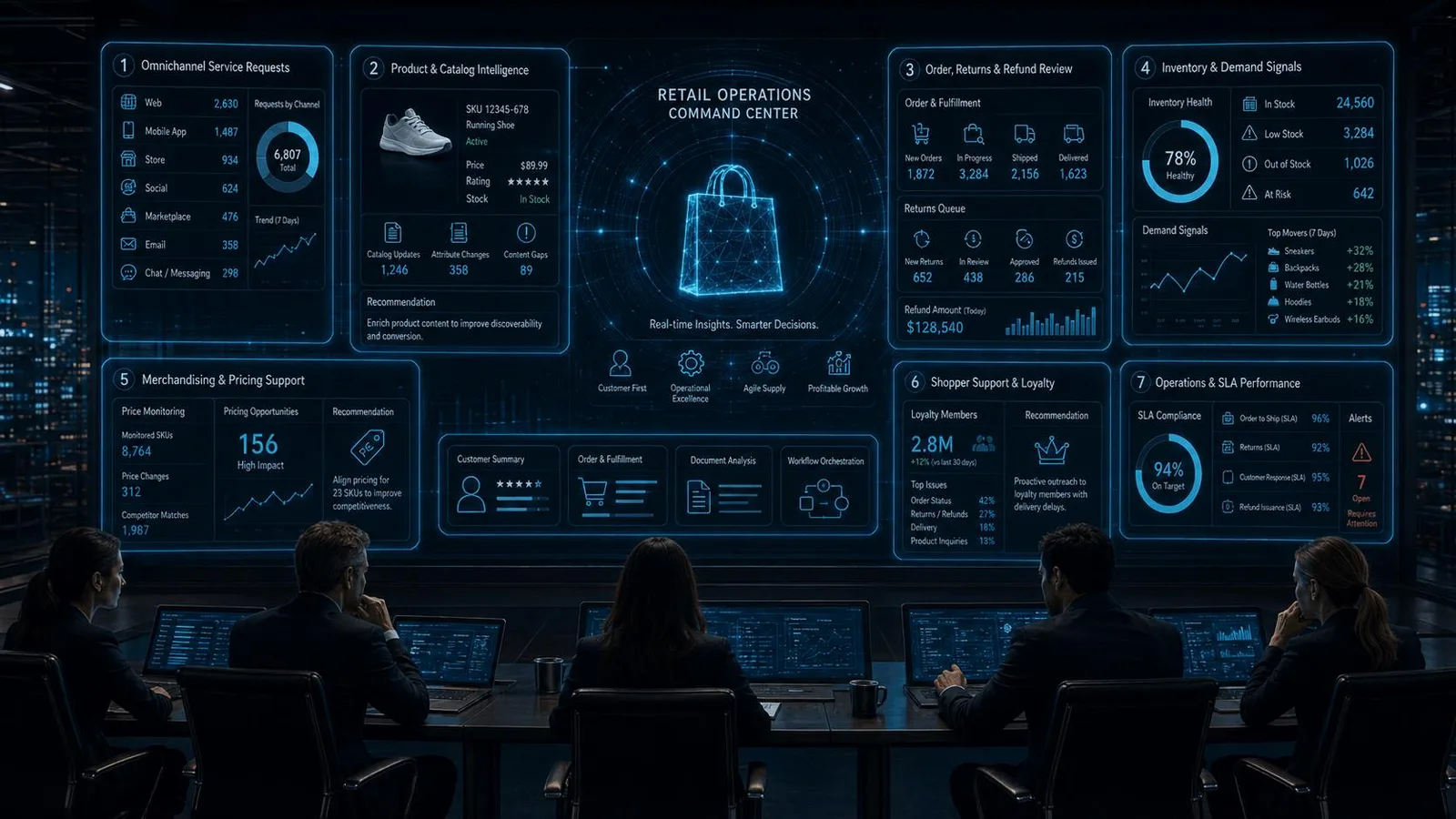
Architecture
A strong retail AI architecture separates data access, consent, model selection, business rules, agent actions, source traceability, and human oversight. That separation matters when workflows touch payments, refunds, prices, claims, privacy, fraud, or customer compensation.
Approved retail data includes product information, customer profiles, orders, returns, inventory, loyalty activity, service conversations, policies, and brand content.
Task and sensitivity router classifies intent, identifies the customer or product, selects the workflow, assesses risk, chooses the model path, and determines approval requirements.
Specialized intelligence combines recommendation models, demand models, fraud and abuse models, task-specific SLMs, policy rules, and private RAG.
Structured outcomes include product recommendations, resolved service requests, enriched product data, return summaries, inventory exception reports, customer themes, and audit trails.
Governance note
Agents should not independently change prices, issue unrestricted compensation, publish regulated product claims, override fraud controls, or ignore customer consent without approved business rules, authorization, and accountable human oversight.
Role-based access, consent controls, and sensitive-data masking
Source traceability and business-rule validation
Human approval for high-value, policy, safety, or fraud exceptions
Audit logs, model monitoring, drift detection, and controlled change management
Related reading
These pages expand the architecture patterns behind local deployment, model routing, private RAG, and cost-aware SLM strategy.
Workshop
You do not need to rebuild the entire retail technology stack. Start with a workflow where customers or teams already experience friction: product discovery, order support, return triage, catalog enrichment, store-associate assistance, consumer complaints, or inventory exceptions.
Select the right first retail workflow for private SLMs.
Assess data, system requirements, governance, and human-review boundaries.
Build and validate a practical agent roadmap for wider adoption.
FAQ
Agentic AI in retail refers to systems that can understand a retail objective, retrieve customer or product context, complete approved workflow steps, interact with commerce systems, and escalate exceptions.
Retail AI agents are specialized systems that support workflows such as product discovery, customer service, order management, returns, catalog enrichment, loyalty, merchandising, and inventory operations.
A chatbot generally answers questions. An AI agent may also retrieve order data, check policies, update records, initiate a return, create a task, or coordinate a multi-step workflow.
A retail SLM is a smaller language model adapted for a focused workflow such as customer-intent classification, product-data enrichment, policy matching, service summarization, or exception routing.
Strong starting points include customer-service classification, catalog enrichment, product Q&A, return-reason analysis, service summarization, supplier-document processing, and store-procedure retrieval.
An SLM can understand the shopper's request and explain recommendations. Product ranking should normally combine catalog retrieval, recommendation models, merchandising rules, live price, and availability.
Agents can collect information, check approved policies, initiate eligible workflows, and prepare refunds. High-value or unusual cases should follow authorization rules and human-review requirements.
Yes. Depending on the workflow, private SLMs and RAG systems can run in private cloud, controlled VPCs, on-premises infrastructure, or hybrid environments.
Private RAG retrieves relevant information from approved product catalogs, policies, brand guidelines, service knowledge, and operating documents and provides grounded context to the AI model.
Use trusted retrieval sources, structured outputs, business-rule validation, live system data, source references, confidence thresholds, restricted actions, and human review.